
Used Haitian for a Family Mould? Check Both Parts in the Same Cycle
Buying a used Haitian for a family mould? Compare cavity-labelled fill evidence and complete sets from the same cycle before agreeing to the press trial.
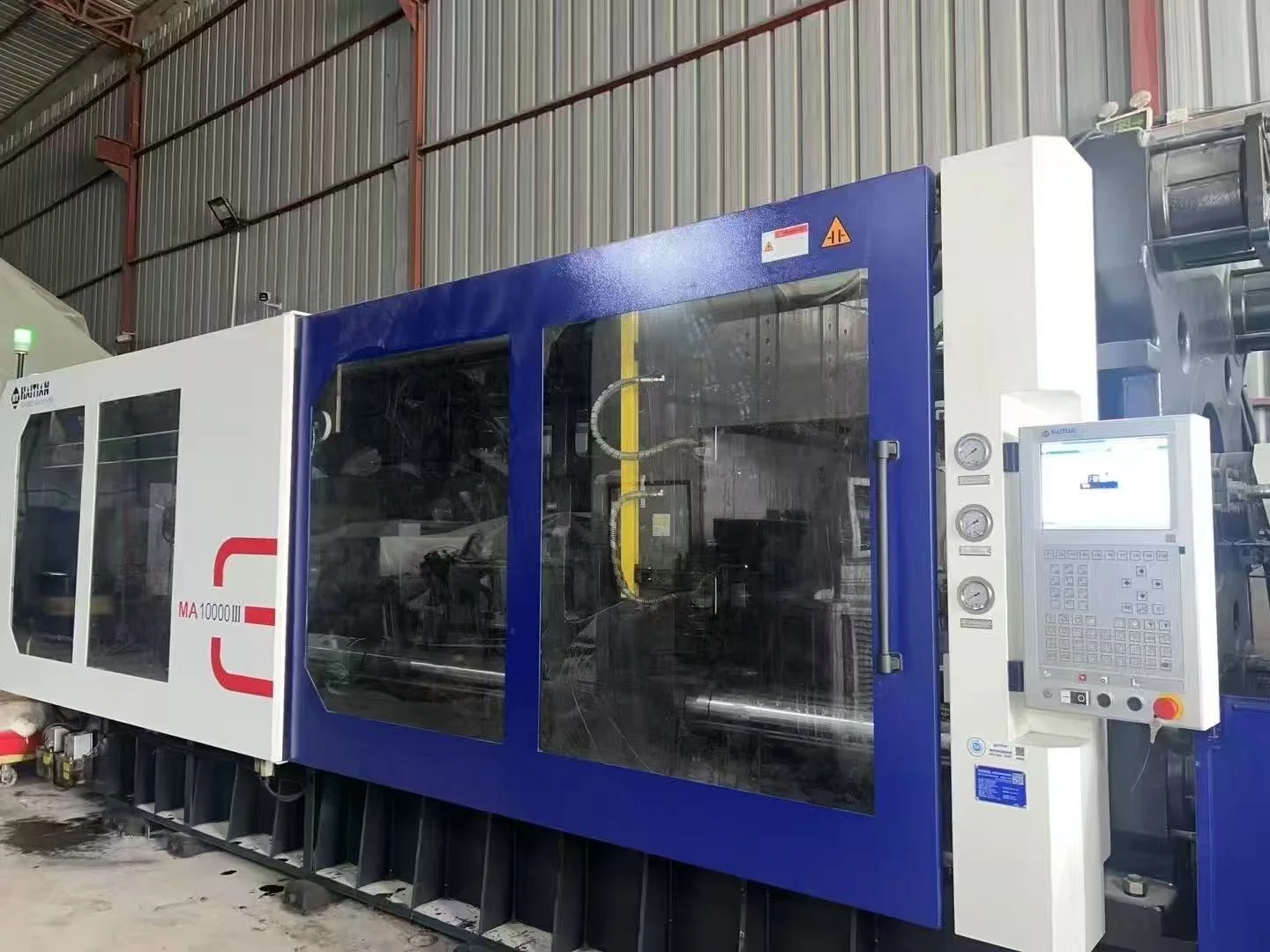
When buying a used Haitian to run a family mould, ask the seller to demonstrate that each part in the set passes its own checks in the same cycle. Keep the samples together by shot and label them by cavity. If the smaller part passes while its larger partner is incomplete, that cycle has yielded an incomplete set, even if the combined shot weight looks right.
Archive photograph: The enclosure in the GEEPOW archive photograph is marked Haitian MA10000 III. It is a machine reference. Request fresh evidence for the serial number under offer and for your own mould trial.
What goes wrong when two different parts share a mould?
A family mould makes different part designs in one tool. For example, a housing and a smaller cover might be moulded in the same cycle. Their nominal weights can differ, so comparing their weights to each other tells you little. Compare each cavity’s result with its own agreed reference and inspect both parts for the defects that would prevent acceptance or assembly.
Autodesk’s Moldflow Adviser describes the risk of unbalanced flow paths in a family mould. One cavity can approach full while another is still filling. A late-filling part can be incomplete while the early-filling part is overpacked. Treat that observation as a reason to investigate the tool and process with the moulding team. A trial result alone rarely identifies which change will resolve it.
Put two different checks in the trial brief
First, capture how each cavity fills
Identify the cavity map, runner or manifold revision and trial resin before the run. If your moulding team can safely release partial parts, request a documented partial-fill diagnostic. Beaumont’s short-shot guidance illustrates why every sample needs a cavity identifier and why the individual shots should remain separate. Ask for the agreed diagnostic stage, photographs of each stage and the repeat results. This lets you distinguish a pattern tied to a cavity from variation across multiple shots.
For mixed geometries, interpret partial-part mass alongside fill progression and that cavity’s own agreed reference. Record which region remains unfilled and whether the pattern repeats. If the tooling or ejection arrangement makes partial-fill testing impractical, agree what evidence can be collected, such as records from existing cavity sensors where fitted. Keep any unresolved fill question open in the purchase record.
Then, count the sets that actually pass
Agree the dimensions, appearance checks and any assembly check before the production trial. Keep one row per cycle and one column per cavity. In a one-housing, one-cover example, a row counts as a good set only when both samples pass their agreed checks. If your plan is to pool components across cycles, separately record that approach and the resulting stock imbalance. Use the agreed acceptance method for the payment milestone.
| Trial observation | Evidence to retain | Buyer decision |
|---|---|---|
| The larger part repeatedly fills late at the agreed diagnostic stage. | Cavity-tagged partial shots, runner revision and trial settings snapshot. | Ask the tool and process teams who will investigate and pay for any correction and repeat trial. |
| Different cavities fall short on different cycles. | Consecutive labelled samples and available machine traces for the same cycles. | Keep the cause open. Have the trial team review run stability before assigning rework. |
| Both parts look complete and one fails the specified fit check. | Same-cycle sample pair, measurement result and drawing revision. | Record the set as failed under the agreed criteria and retain both parts for review. |
| The seller runs only a demonstration tool. | Demonstration tool, material and offered press serial number. | Record the scope demonstrated and set a separate milestone for your family mould. |
Match the injection unit to the whole tool
Share the combined production shot for all cavities, including any cold runner ejected each cycle, and the resin grade. Use the applicable press documents to check the injection unit and your mould dimensions before committing to a trial. Haitian lists multiple screw options for its MA10000 III/8400 catalogue configuration. Confirm the full code, installed screw and usable capability against the individual press. The MA10000 III machine reference shows which details the catalogue and the archive photo can each support.
When you compare offers in the 500–3,300 metric-tonne used injection moulding machine range, keep the same tool revision, acceptance criteria and test scope. If a seller changes the proposed press or injection unit, note the change and have the trial team review it before reusing the earlier results.
Questions buyers ask
Can the machine supplier prove balance with a shot-weight printout?
Repeated weights measured for the complete shots can show aggregate repeatability if the measurement basis stays fixed. Retain cavity-specific samples and results to see which individual part passed. A steady aggregate can conceal differences between cavities.
Can we accept the press before the production mould arrives?
You can agree a staged purchase if each milestone has a written scope, evidence and named responsibility. Identify which payment or acceptance step depends on the family-tool trial, and agree who bears the cost if a repeat is needed. Use this used-press acceptance test guide to put the trial and open items into writing.
Preparing a family-tool transfer? Send your cavity map, part and resin details, current sample criteria and any candidate nameplate through the GEEPOW inquiry form. We can discuss what evidence to request for a machine-specific quotation.
Sources
- Autodesk Moldflow Adviser 2024 Help — Unbalanced flow in family molds
- Beaumont Technologies — Proper Procedure for Collecting Short Shots, multi-cavity section (15 April 2015)
- Haitian Plastics Machinery — Mars III technical catalogue HT 20200805-CV, MA10000III/8400, printed pp. 10–11 (Haitian Mexico PDF)