
Used Injection Moulding Machine With a Dryer? Test It at Your Resin Throughput
Assess a dryer bundled with a used injection moulding press. Check working hopper fill, temperature, air dew point and pellet moisture at the planned resin rate.
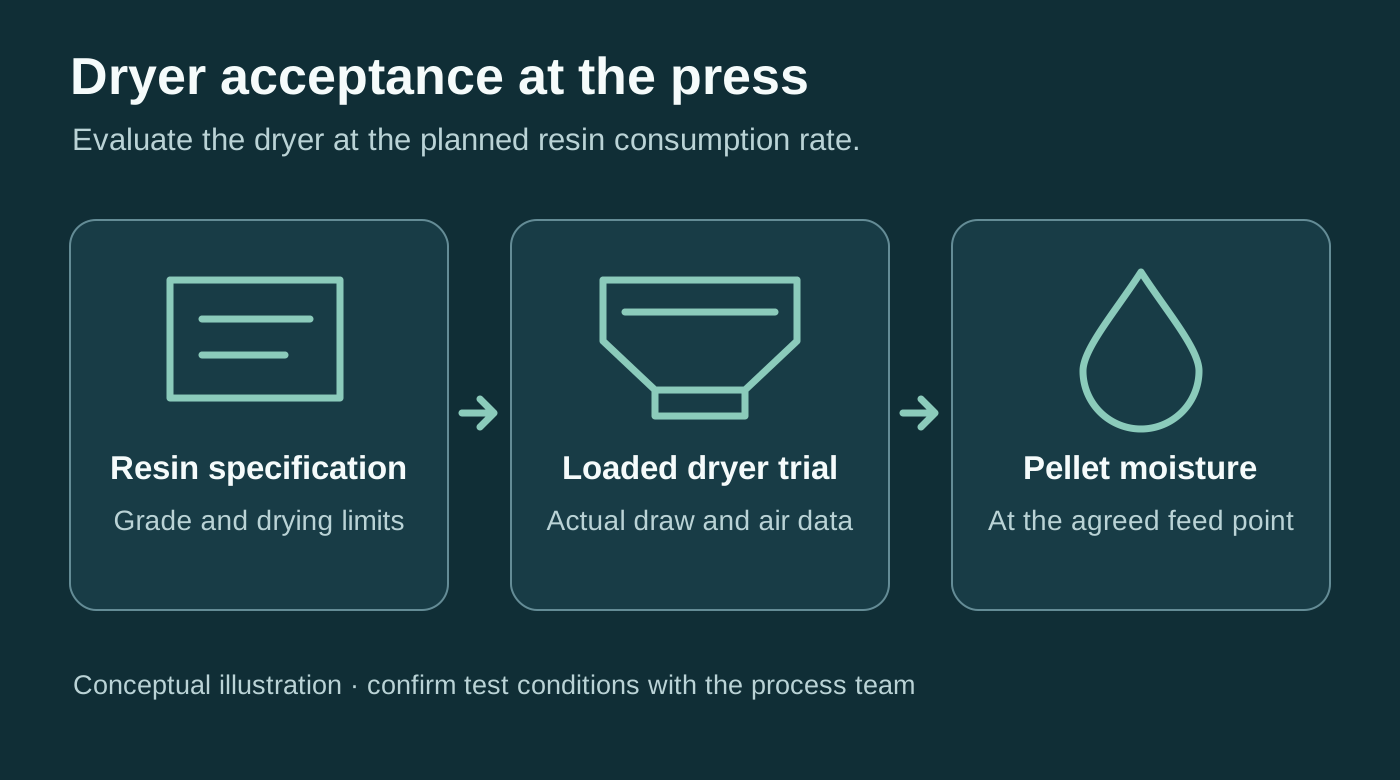
If a used injection moulding machine comes with a desiccant dryer, ask for a loaded run with your resin grade at the planned consumption rate. Agree in advance how to measure pellet moisture at an approved point close to the press feed. Record the actual hopper fill, drying air conditions and transfer path. The combined evidence tells you whether the included dryer and hopper can support the job you are buying the press for.
Conceptual illustration of a buyer’s evidence chain. Equipment, settings and sampling points depend on the installation.
Start with the resin and the fastest planned job
Identify the full resin grade and planned blend. Obtain the material supplier’s drying time and temperature guidance, its residual moisture limit if specified, and a suitable moisture test method. Eastman’s Tritan copolyester guide gives an example of how a resin supplier pairs a pellet moisture target with suitable measurement methods. Set your trial criteria from the grade actually being purchased and confirm any allowable exposure after drying.
For a first estimate of consumption, multiply resin used per shot by expected cycles per hour. Include cold runners and any other material that the dryer must actually supply. Compare that rate with the working pellet mass in the hopper at its normal fill level. For example, an assumed working mass of 72 kg at 24 kg/h gives three hours of nominal residence. That is an inventory screen. Flow pattern, hopper fill and heat-up time determine how much effective drying time the pellets receive. Ask the dryer supplier to check the sizing before using the calculation in a purchase decision.
Ask for an acceptance record with four fields
- Equipment and loading. Record the dryer and hopper model, hopper fill level, resin grade and actual draw rate. Identify whether the loader, hoses, filters and moisture instrument shown in the trial are included or supplied by the buyer.
- Process air. Ask for the actual inlet air temperature, available airflow evidence and dew-point reading, with their measurement locations and timestamps. Include relevant alarms and sufficient run time to observe the normal dryer cycle at the agreed load.
- Pellet moisture. Agree on the sampling point, handling method, instrument and acceptance limit with the material supplier or process team. If pellets are conveyed from the dryer to the press, check whether the agreed feed point remains within the target after transfer.
- Purchase decision. Record whether the result covers the planned throughput. If the seller uses a different grade, lower feed rate or shorter convey route, write down the conditions and specify which result must be repeated during commissioning.
Conair’s manual lists temperature, residence time, airflow and dew point as separate drying factors. It also identifies restricted air paths and low hopper levels as possible causes of drying trouble. A dew-point reading describes the process air at its measurement point. Use a pellet measurement and the trial record to assess the result at the machine.
Questions that change the quotation
Can a seller demonstrate the dryer with an empty hopper?
An empty-hopper check can document power-up and control behaviour. Ask for a loaded test to assess drying capacity and pellet condition under the draw rate you expect.
What if the press and dryer are sold by different suppliers?
Put the dryer and hopper on a named equipment list and assign someone to check the conveyor, utilities and feed-point moisture as an assembled cell. Use the auxiliary equipment selection guide for the scope and the used machine acceptance guide to record what will be witnessed.
Discuss a used press and dryer package with GEEPOW. Send the resin grade, maximum expected kg/h, destination and the model numbers of any equipment already offered.