
Can Your Factory Floor Support a Large Used Injection Moulding Machine?
Check support loads, mould mass, mounting hardware and site records before buying a 500–3,300 t used Haitian, YIZUMI or Chen Hsong injection moulding machine.
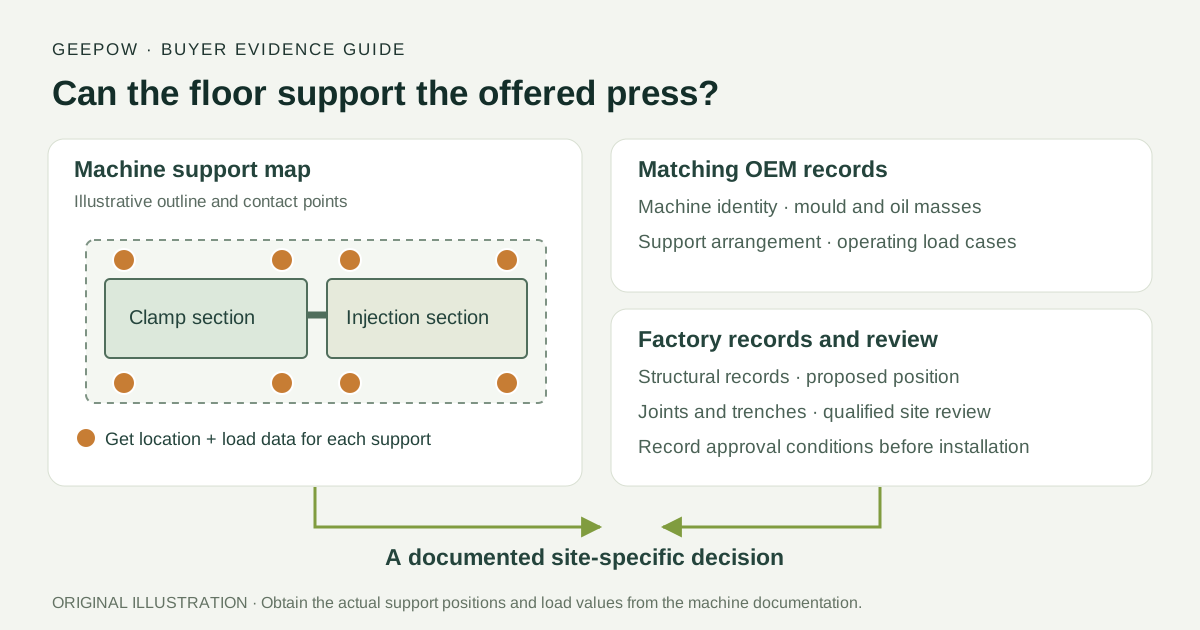
Before buying a large used injection moulding machine, obtain its installation drawing and support-load information, then have the proposed location reviewed against the actual factory floor. A useful purchase decision needs operating mass, mould mass, mounting positions and applicable dynamic-load data. The machine's overall length and width provide only part of that evidence.
This matters when sourcing a used Haitian, YIZUMI or Chen Hsong press in the 500–3,300 metric-tonne clamp-force range. Keep the clamp rating in its original unit from the nameplate or OEM record, and record the machine's mass separately. Your question is whether the floor can support the offered configuration at its actual contact points.
Illustration note: the diagram shows the documents that connect a machine-support plan to a site review. Its support locations are illustrative. Obtain the mounting arrangement and load values for the individual press.
Ask where the load reaches the floor
A seller may provide a machine mass and a brochure footprint. Dividing those figures produces an average across the outline, while the installation drawing identifies the feet or other supports through which the machine loads the floor. Ask for the drawing revision, support locations and load information together, so the structural reviewer can assess the proposed position.
Husky's HyPET6e/HPP6e manual makes the distinction concrete. Section 7.1.3 treats the clamp unit plus mould separately from the injection units plus hydraulic oil, using the area of their levelling mounts for the static-load calculation. It also addresses machine motion in its total-load calculation. Those calculations apply to the documented Husky configuration. For an offered Haitian, YIZUMI or Chen Hsong machine, request the applicable manufacturer's foundation and operating-load information.
Separate the machine evidence from the building evidence
The following is an original buyer's request table. Use it to assign missing information before agreeing to installation work. The reviewer decides which further investigation or calculation the site needs.
| Evidence to obtain | Who can supply it | Decision it supports |
|---|---|---|
| Full model, serial number and installed configuration | Seller, checked against nameplate and OEM records | Whether the installation drawing actually belongs to the offered press |
| Operating masses and included equipment | Applicable machine documentation and confirmed offer scope | Which loads to include for the press, oil, mould and attached equipment |
| Support plan and load data | OEM or its relevant technical documentation | Where reactions enter the floor and which operating cases require review |
| Installed feet, wedges or anchors | Dated photos, identification and condition inspection | Whether the delivered support hardware matches the approved arrangement |
| Floor construction and proposed location | Building owner and available structural drawings or surveys | What is known about the slab or supporting structure beneath the machine |
| Joints, trenches and neighbouring foundations | Site drawing and on-site observations | Which local features the structural reviewer must assess at the proposed supports |
| Written site review and installation conditions | Qualified structural reviewer and responsible installation team | Whether the position is accepted, needs work or remains unresolved |
Check the support hardware included with a used press
Photograph the existing mounting components before dismantling, and ask the seller to identify what is included in the shipment. Record missing components and proposed replacements in the quotation. This gives the installer a defined hardware list to compare with the approved machine arrangement.
Bilz's technical information illustrates why identification matters. Its levelling-element size and pad selection depend on application and load, and its stated maximum load includes both static and dynamic machine loads. Ask the machine maker and mounting supplier to confirm the proposed combination and conditions. A foot's appearance or a single advertised load figure leaves the complete mounting arrangement unresolved.
For used hardware, request a condition check alongside its type and rating. Ask how damaged threads, missing plates or deteriorated pads will be addressed, and who approves any change in component type. Photographing the original supports helps establish what was inspected and what eventually arrives.
Put the decision ahead of the shipping commitment
- At shortlisting, request the load pack. Collect machine identity, installed configuration, mounting drawing and stated load cases while comparing offers on the large used injection moulding machine sourcing page.
- Before fixing the position, share the site records. Give the reviewer the proposed support locations on the factory drawing, the available structural information and recorded uncertainties.
- Before dispatch, close the responsibility gaps. Put any required site work, mounting components and installation responsibilities into the written scope. Record the consequence of an outstanding review in the purchasing decision.
- At installation, compare delivery with the approved plan. Have the responsible team confirm that the actual equipment, supports and position correspond to the reviewed arrangement, and retain the installation and levelling records.
Review the complete cell layout alongside the floor-load enquiry, including mould transfer and service access.
Questions buyers ask
Does a 1,000-tonne press weigh 1,000 tonnes?
The advertised tonnage usually identifies clamp force. Obtain the nameplate rating and its unit, then request the actual operating masses and support-load data separately. Keep each value labelled when sending the enquiry to the site reviewer.
Can the floor that supported our previous machine be accepted immediately?
Provide the old installation as background and have the proposed press assessed in its intended position. The reviewer needs the new support arrangement, loads and available site information to reach a decision.
Is there one concrete thickness for this clamp-force range?
The site review must establish the foundation requirements for the actual structure, support positions and operating loads. Ask for a written decision tied to those inputs. A tonnage range or brochure footprint leaves those inputs incomplete.
Bring the floor evidence into your sourcing enquiry
Send GEEPOW your target press, mould mass and destination. If you have selected a factory position, include its available drawing and describe any missing machine or site records. This lets the sourcing discussion identify the documentation your installer and structural reviewer need before the machine is dispatched.