Used Haitian for 240L Bins: Check the Collection-Lifter Interface
Select a used Haitian for 240L bins with a defined receiver drawing, traceable trial samples and qualified collection-lifter interface acceptance.
For a two-wheel 240L bin project, select a used Haitian against the intended collection-lifter interface as well as the moulding requirements. Ask the bin designer and collection-equipment provider to define the receiver geometry and acceptance evidence before the machine trial. Nominal volume, an acceptable-looking body and a large clamp rating do not answer that interface question.
This guide addresses used-machine sourcing within a 500–3,300 metric-tonne clamp-force range. Record each offered press’s actual nameplate force and original unit separately. The range does not identify the required machine, confirm availability or establish the performance of the finished bin.
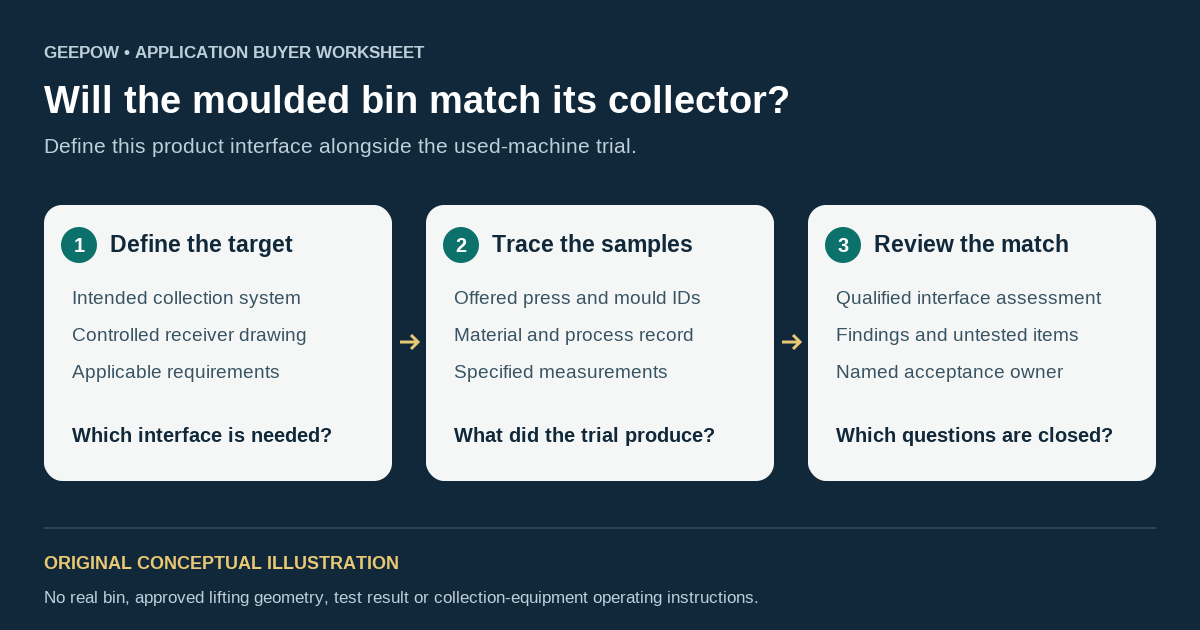
Illustration: an original purchasing worksheet linking the product drawing, traceable samples and qualified interface review. It is not a photograph, lifting design, test result or instruction for operating collection equipment.
Keep the application example and the candidate machine separate
Haitian’s logistics application page lists a 240L waste bin in PP on an HA21000/32500 PEGASUS, with a reported shot weight of 9.5 kg. That listing does not identify the collection-lifter interface or establish compliance for a different bin. Its shot figure is not an assembled-bin weight or a specification for a used Mars.
For a separate candidate-family reference, Haitian’s Mars III specification HT 20200805-CV lists the MA10000III/8400 at 10,000 kN clamp force. Its injection-weight data use a PS reference material and distinguish screw configurations. These are catalogue records for that configuration, not measurements of an offered press or a basis for transferring the HA example’s PP shot requirement.
For an initial drawing check, the reference MA10000III/8400 has 1,160 × 1,160 mm tie-bar spacing and 1,220 mm opening stroke. These do not define the mould-loading route or the assembled tool’s part-extraction clearance. Compare the controlled drawings and access plan, then verify the installed equipment. Hold shortlisting if the geometry or actual injection package remains unidentified.
The following comparison is documentary, with no real offer or machine-selection result. A seller proposing a Mars for your bin would still need to identify the actual injection package, applicable original data and a relevant trial. Matching a broad clamp-force class does not close that review.
| Documentary reference | What is established | What remains open |
|---|---|---|
| Haitian HA application | Listed PP 240L bin and identified machine. | Target receiver and collection-system qualification. |
| Mars III specification | Clamp force, screw options and labelled injection weight. | Offered machine identity and actual application fit. |
Keep the PP application and PS catalogue weight bases labelled separately. Require a material-specific shot and installed-capacity assessment rather than equating their masses. Review the actual mould and process alongside the collection interface.
Define the collection interface before approving the moulded body
ESE’s July 2022 operating manual, Rev. 02, applies to its stated container products. Annex 1, page 15, explains that a comb lifting device should support the container’s frontal receiver across its width. This illustrates an interface question for your designer and collection-equipment provider; it is not an operating procedure or approval for a Haitian-moulded bin.
Start with the collection operation that will receive the bins. Ask which lifting system is intended, who controls its requirements and which bin drawing revision it will assess. A general description such as “standard wheelie bin” leaves the required interface unresolved. Identify any customer-specific requirements separately from a standard reference.
DIN Media’s public scope for DIN EN 840-1:2021-01 addresses dimensions and design of two-wheel containers up to 400 litres for comb lifting devices. The public page identifies the reference, not the full dimensional requirements or test methods. Have the responsible specialists obtain the applicable documents and determine the requirements for your intended collection system.
Ask the toolmaker to mark the moulded features and measurement points that implement the approved receiver design. Include the drawing revision, specified tolerances and inspection method in the trial brief. If wheel, lid or other options affect the proposed interface assessment, have the responsible specialists identify which complete configuration the review covers.
Use a short product-interface acceptance record
This original worksheet organises the buyer’s request. It supplies no dimensions, loads or universal pass limits.
| Acceptance record | Identify before comparing offers | Buyer decision |
|---|---|---|
| Collection system | Intended lifter and provider’s interface requirements. | Correct target? |
| Bin geometry | Controlled receiver drawing and specified measurements. | Features defined? |
| Trial samples | Machine, mould, material and sample identities. | Results traceable? |
| Interface review | Qualified assessment, observations and unresolved findings. | Scope accepted? |
Keep this record distinct from the mould’s attachment to the press and the take-out robot’s connection to the controller. Those production interfaces answer how the bin is moulded and removed. This review asks whether the resulting product matches its intended collection equipment. Use the mould-fit guide for the separate machine-tool assessment.
Tie the receiver measurements to the used-machine trial
Agree with the designer which features must be measured, when samples are assessed and how the sampling plan represents the proposed run. Record the mould identity, material specification and lot, machine serial number, installed injection configuration and the process record for the retained samples. Ask which changes require further review rather than assuming one approved sample covers a later setup.
Record the actual findings against the controlled drawing, including samples rejected for the relevant features. Keep the samples and reports identifiable so a reviewer can trace an interface concern back to the trial that produced the part. If a sample was modified after moulding, identify that work before treating its dimensions as evidence of the moulding process.
Use the machine acceptance-test guide to define the press demonstration. A product drawing review, a dimensional report and any agreed collection-equipment assessment should each state what was checked and what remains unresolved. This guide provides no vehicle adjustment, loading sequence or lifting procedure.
Compare the included application work
Illustrative offer comparison: one seller provides a running video and a sample described as “240L”. Another supplies a defined bin revision, traceable measurement samples and an agreed scope for the receiving specialist’s interface review. Before assigning value, ask what each package actually includes and which outstanding assessments require separate work.
Name who supplies the approved product drawing, reviews the proposed tool, records the moulding samples and arranges the collection-interface assessment. Agree how an out-of-tolerance sample or unresolved interface affects the acceptance milestone. Request the necessary technical proposal and quotation instead of assuming that a different machine setting or a later mould change will solve the issue.
Do not treat a third-party container maker’s instructions as certification for your product. The intended bin, its material and construction, the proposed collector and the applicable requirements need their own qualified review. Neither an OEM application listing nor a brochure clamp rating establishes that outcome.
Buyer questions
Does a 240L label identify the lifting interface?
No. State the intended collection system and controlled receiver design, then agree the applicable dimensional and interface evidence with the responsible providers.
Does a bin leaving the mould cleanly prove collection compatibility?
No. Demoulding and downstream collection are separate interfaces. Retain the product-specific drawing, measurement and qualified review records for the latter.
Can I use the ESE manual as my bin’s approval?
No. It is a dated, product-specific technical reference. Obtain the requirements and assessment applicable to your own bin and collection equipment.
Prepare a 240L bin selection brief
Review the 500–3,300 tonne used injection moulding machine sourcing page, then send your bin project and collection-interface requirements. Include the product and receiver drawings, intended collection system, mould and material information, candidate machine records and outstanding review scope. Request a machine-specific proposal tied to those requirements.
Sources
- Haitian International Vietnam — Logistics: 240L Waste Bin application (undated page)
- Haitian Plastics Machinery — Mars III specifications HT 20200805-CV, MA10000III/8400, printed pp10–11
- ESE — Operating Instructions for Mobile Waste and Recyclables Containers, July 2022 Rev.02, Annex1 p15
- DIN Media — DIN EN840-1:2021-01, public dimensions-and-design scope for two-wheel comb-lift containers