
Used Haitian for Folding Crates: Verify the Tooling Set
Select a used Haitian for folding crates by tracing component revisions, moulds and modules to the complete assembly, included tooling and agreed acceptance checks.
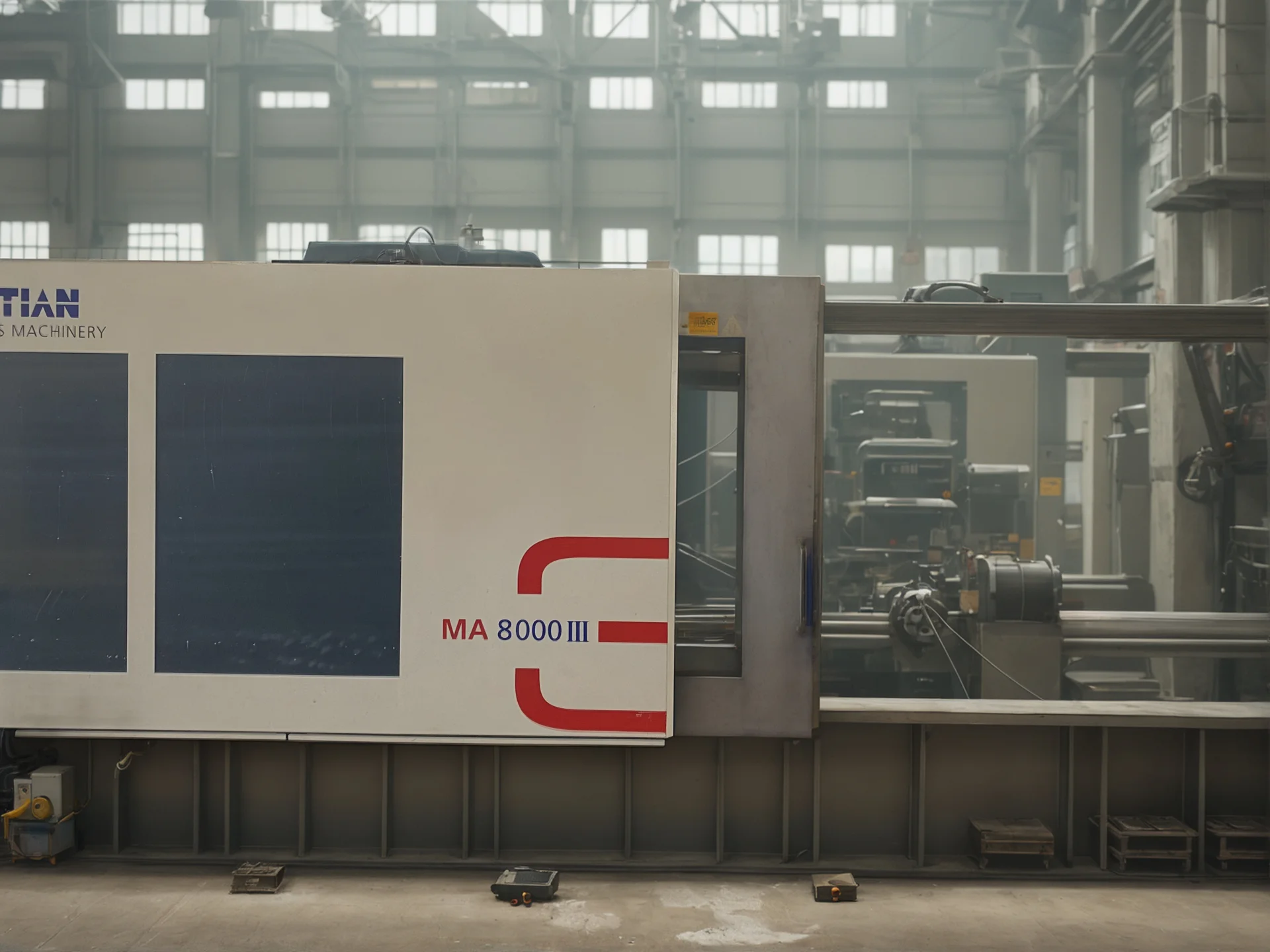
For a folding-crate project, select a used Haitian against the complete, identified tooling and component set for the crate you need to assemble. Before comparing machine offers, establish which product revision is intended, which tools produce its parts, what is included and how the assembled crate will be accepted. One attractive moulded sample leaves those questions open.
This guide addresses buyers sourcing within the 500–3,300 metric-tonne clamp-force range. Record the offered machine’s actual nameplate force and original unit; do not derive its rating from a model number. The required press, mould configuration, condition and availability remain specific to the proposed project.
Photograph: existing GEEPOW site archive, enclosure marked Haitian MA8000 III. Reused unchanged as Mars-family context for assessing a used candidate. It is not the HA application below and does not show this crate, confirm the machine’s clamp rating or establish current stock or condition.
Read the documented folding-box application with its limits
Haitian’s Vietnam logistics page documents a PP collapsible turnover box made with a modular mould set and lists HA10000/HA8000/HA12000. It does not map those designations to individual components or identify the supplied tooling. The example establishes a documented application to investigate, not a specification for a used Mars or proof that another crate’s parts will interchange.
Ask the crate designer or toolmaker for the actual configuration register. If the design uses a base, different wall panels, separate locks or hinge hardware, identify every item and how it is supplied. Do not assume those examples describe Haitian’s published box, or that every item is injection moulded. Retain the approved assembly drawing alongside the part drawings.
Turn “crate mould included” into a controlled list
The following original worksheet is a request for project records, not a bill of materials for the manufacturer’s example. Complete it using the intended design and remove inapplicable entries.
| Record | Identify in the project file | Buying question |
|---|---|---|
| Crate variant | Controlled assembly drawing and revision. | Which complete product? |
| Component | Part revision, quantity and supply route. | Anything missing? |
| Mould/cavity | Tool ID, cavity map and insert revision. | Correct part set? |
| Interface | Designer-approved joining, locking and stacking criteria. | Compatible assembly? |
| Delivery | Tools, spares, documents and accepted samples. | Scope complete? |
For each mould, identify every cavity and any replaceable insert or module. Ask which drawing revision each combination is intended to produce and who controls changes. Where a tool can produce several variants, request the documented configuration for each variant you intend to buy. A list of loose inserts without that mapping leaves the supplied product range unresolved.
Keep the assembled-crate revision visible when comparing parts. If the design permits different sides, locks or bases to be combined, have the designer identify the permitted combinations. Do not infer interchangeability from matching colour, similar dimensions or a seller’s description of “compatible modules”.
Screen the used Mars against each identified tool
Haitian’s Mars III specification HT 20200805-CV gives a separate documentary reference for the photographed family. On PDF page 5, printed pages 8–9, the MA8000III/6800 entry states 8,000 kN clamping force, 1,000 × 1,000 mm tie-bar spacing and a 420–1,000 mm mould-height range. These catalogue values apply to that stated configuration; the photograph does not establish its injection-unit suffix, nameplate rating or installed equipment.
Obtain the applicable documents for the individual candidate, then review each proposed tool against them. Include its installed configuration, mounting, required movements, injection requirements and relevant options. Use the mould-fit dimensions guide for the mechanical checks. Keep the result as a tool-by-tool assessment rather than a single tick beside “folding crate”.
The HA designations in the application listing and the MA8000 III marking in the photograph are different documentary references. Shared numbers do not establish identical machinery. Ask the responsible provider to identify why the offered press and installed injection package suit the actual moulds, material specifications and component requirements.
Identify missing tooling before valuing the package
Request an itemised inclusion list covering the moulds, identified modules, specified assembly hardware, available spares and relevant drawings or instructions. Ask who owns the tooling, who can supply missing components and what documents or authorised access transfer with the sale. Have the parties record any restrictions and unresolved items in the quotation.
Distinguish an inspected tool from a seller’s intention to find an equivalent one later. If an essential lock component or mould module is absent, request the technical proposal, acceptance evidence and separate quotation needed to close that gap. Do not estimate the missing work from the asking price of the press or assume that another tool’s insert can be adapted.
Accept an assembled crate from traceable trial parts
Agree with the designer or customer which component dimensions and assembly functions the trial must demonstrate. Possible requirements to define include erecting and folding the crate, engagement of its specified locks or joints, the agreed fit between components and its intended stacking interfaces. These are buyer-defined acceptance topics, not universal test limits or results from Haitian’s published example.
Identify the mould, cavity, insert configuration, material and sample lot for the parts retained. Where interchangeability is required, have the designer specify which cavity or variant combinations must be assembled and assessed. Record rejected assemblies and their component identities as well as accepted samples. A successful assembly of selected parts should not silently stand for combinations that were not checked.
Use the used-machine acceptance-test guide for the press trial and retain the approved assembly checks as a named application deliverable. The result supports the conditions actually assessed. Any additional service-load or durability qualification your customer requires needs its own agreed plan and evidence.
Work through one incomplete-set example
Illustrative purchasing scenario: a seller demonstrates a panel mould and provides a folded crate sample. The buyer asks which tools, component revisions and hardware produced that sample. If an essential tool or module is excluded, the offer still needs its supply and acceptance scope defined. If everything is included, connect the proposed trial parts to the same approved assembly revision before treating the package as complete.
This example assigns no price, repair outcome or delivery promise. It gives the buyer a specific unresolved item to close before ranking the complete machine-and-tooling offers.
Buyer questions
Does Haitian’s modular-mould example prove that my crate variants interchange?
No. Obtain the designer’s permitted combinations and the corresponding tooling records, then agree the assembly evidence for your intended variants.
Does the MA8000 III photograph prove suitability?
No. It is an authorised archive reference for the Mars family. The individual offer needs its nameplate, installed equipment, tool review and trial records.
Can an assembled sample replace the tooling inventory?
Use the sample to define the target product, then trace its components to the tools and configurations included. Identify any bought-in parts and unverified supply items separately.
Prepare a folding-crate selection enquiry
Review the 500–3,300 tonne used injection moulding machine sourcing page, then send your folding-crate machine and tooling brief. Include the assembly revision, component register, mould and module list, material specifications, machine records, destination and unresolved inclusions. Ask for the proposed configuration and acceptance scope to be identified before comparing package value.