
Used Haitian: Compare Injection Pressure Before Choosing a Press
Compare used Haitian injection-pressure claims by pressure basis, units, screw configuration and process stage before ranking offers or agreeing a machine trial.
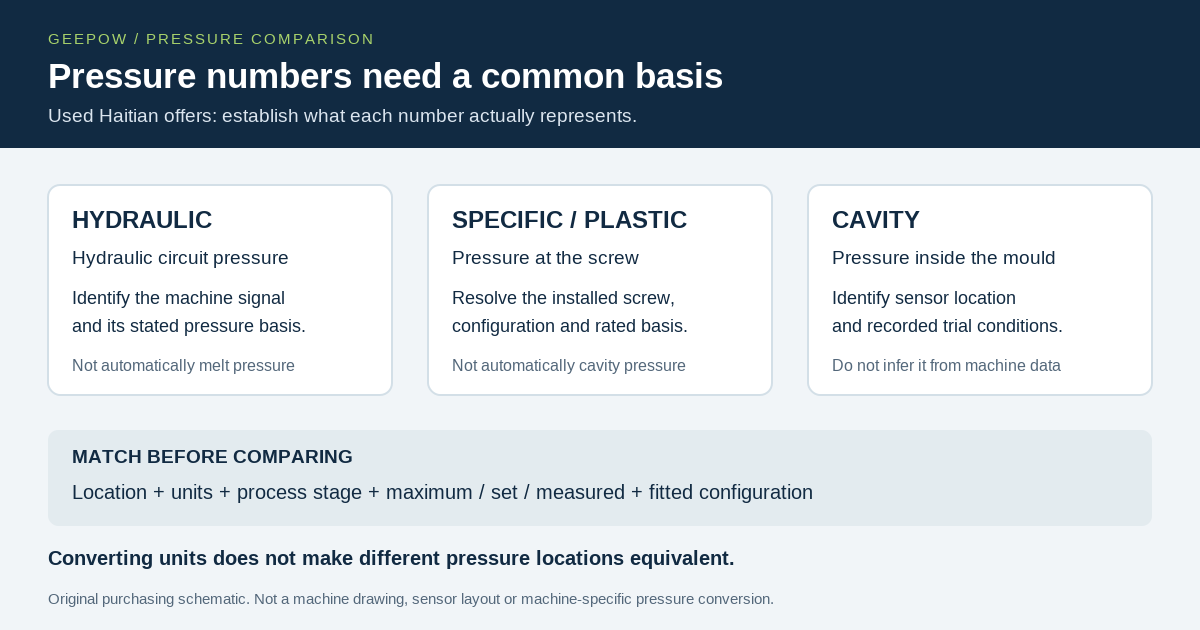
Before comparing injection-pressure figures on two used Haitian offers, establish the pressure basis, unit, installed injection configuration and process stage behind each number. A larger figure deserves no purchasing premium until the two records describe comparable quantities.
For used or refurbished Haitian sourcing in the 500–3,300 metric-tonne clamp-force procurement range, record each candidate’s full nameplate, original force unit, series, generation and serial number separately. A model number does not establish a tonne rating. This range describes the sourcing brief; individual availability, condition and configuration require confirmation.
Illustration: an original purchasing worksheet showing pressure locations and comparison fields. It is conceptual, with no actual machine, sensor result or approved process setting.
Identify what the seller’s number describes
Start with the original evidence rather than a retyped specification. Request the complete screen capture or document page, including its heading, units, machine identity and revision. If an offer says only “maximum pressure”, ask which machine function and which documented configuration it refers to before adding it to the shortlist spreadsheet.
RJG’s injection-pressure explanation distinguishes fill, pack and hold stages and presents pressure as force divided by area. For purchasing, retain the original screen label and identify whether the quoted number is a catalogue entry, a setpoint, a pressure limit or an observed reading. Ask the technical reviewer to explain that distinction for the offered controller.
Keep a unit-conversion column separate from the technical interpretation. For example, 1 MPa equals 10 bar; 160 bar and 16 MPa express the same pressure. That arithmetic does not establish where either pressure was measured. A percentage display needs the controller’s documented reference before it can enter a numerical comparison.
Keep the screw column with the catalogue value
Haitian’s Turkish MAⅢ/SE specification, cover code HT 20240422-IV, gives a useful example. On PDF page 5, the MA5300Ⅲ/4000SE columns pair 80, 85, 90 and 100 mm screws with injection-pressure entries of 199, 176, 157 and 127 MPa respectively. Its clamping-force row separately states 5,300 kN. These are entries for that edition and configuration. They neither identify an offered used press nor establish its installed screw, measured capability or pressure-display basis.
Attach the complete relevant page to each offer file. Ask the seller to identify the installed screw and injection unit, any replacement history, and the document that matches the resulting configuration. If those records conflict, leave the pressure comparison unresolved while the responsible specialist establishes which data apply.
Use the shot-size and resin matching guide for the wider application review. Here, the task is narrower: preserve the meaning of a pressure number when it crosses from a brochure, controller or production record into a purchasing comparison.
Put both offers through one comparison worksheet
This original worksheet organises the evidence for your reviewer. Complete every field for each candidate and retain the supporting files alongside it.
| Comparison field | Offer A and offer B: retain | Decision |
|---|---|---|
| Pressure basis | Hydraulic, plastic or cavity; documented location. | Same basis? |
| Unit | Original unit and checked conversion. | Same scale? |
| Configuration | Installed screw, injection unit and applicable documentation. | Correct hardware? |
| Stage and quantity | Fill/hold; limit, setting or actual reading. | Same quantity? |
| Trial record | Machine identity, conditions and retained data. | Evidence comparable? |
Give each row an owner and a disposition: confirmed, needs clarification, or excluded from the comparison. Keep the original entry visible after any conversion. This lets procurement see exactly which apparent advantage survives review and which still depends on missing documentation.
Convert a pressure basis only with configuration evidence
RJG’s Bob Reese paper explains hydraulic-to-plastic pressure conversion using the injection-cylinder area divided by screw area as the intensification ratio. Hydraulic pressure multiplied by that ratio gives plastic pressure ahead of the screw. Obtain the applicable documented ratio for the installed configuration; do not assume one from another machine.
The paper concerns transferring moulding processes and is available as a historical technical reference. Its PDF metadata is dated February 2010; it is not a Haitian controller manual. Its conversion relationship does not determine your machine’s ratio or predict the pressure inside your particular mould cavity.
Have the technical reviewer state the evidence, calculation and resulting basis on the comparison sheet. If the controller already displays plastic pressure, record that confirmation before considering any further conversion. Keep unresolved sensor location, display interpretation or configuration questions in the offer’s evidence list rather than filling gaps with an assumed ratio.
Make the unresolved items concrete before a trial
A useful quotation should say what will be supplied to close the comparison. Request these deliverables for the specific candidate:
- Machine and injection-unit identification photographs, with the applicable original specification or manual revision.
- A controller-screen explanation from the responsible technical reviewer, tied to the installed software and hardware.
- The source of any conversion factor, the calculation record and the person responsible for checking it.
- A written list of unavailable evidence, proposed investigation and any separately quoted work.
- The intended mould, resin, production requirement and acceptance records that the trial will address.
For a refurbished offer, distinguish completed work from proposed work and request the corresponding records. Ask who supplies the missing evidence and how its acceptance affects the quotation. This creates a defined commercial question without assigning an invented repair allowance or promising that a change will be feasible.
Use the agreed trial to assess the offered machine
Once the figures have been interpreted, agree what the production trial must demonstrate for your job. Keep the machine identity, mould, resin, recipe revision, observation conditions and retained records together. Ask the reviewer to explain any difference between the quoted claim and what was observed, then document remaining acceptance items.
The Haitian Mars III operating-temperature trial guide addresses a separate condition question. A stable run supports observations under the agreed conditions; it cannot identify the meaning of an undocumented pressure field. Conversely, a correctly interpreted brochure entry still needs a relevant machine trial.
Buyer questions
Does converting bar to MPa also convert hydraulic pressure to plastic pressure?
No. Unit conversion changes the scale. Changing from hydraulic to plastic pressure also requires the applicable intensification ratio.
Can I apply the 2024 MAⅢ/SE example to an older Mars III?
Use it as an example of why the complete column matters. Request the documentation applicable to the actual generation and installed equipment before using a numerical value in your decision.
What if the seller cannot explain the pressure field?
Keep it unverified. Ask for the applicable documentation and a qualified interpretation before using the figure to rank offers. Agree the missing deliverable and any investigation scope in writing.
Prepare a used Haitian comparison brief
Review the 500–3,300 tonne used injection moulding machine sourcing page, then send GEEPOW your used Haitian pressure-comparison brief. Include both offers, nameplates, original pressure records, installed screw details, mould, resin and destination. Mark the unanswered fields so the enquiry starts with the evidence your buying decision needs.
Sources
- Haitian Plastics Machinery — MAⅢ/SE specifications, Turkish edition HT 20240422-IV (PDF p5, printed 08–09)
- RJG, Bob Reese — Medical Molding: Revalidation of Injection Molding Processes Using Universal Setup Data (PDF pp3–4; 2010 metadata)
- RJG — Injection Pressure: What Is It, How to Calculate It, and Why It Matters? (published 31 May 2023; modified 23 June 2026)