Used Haitian Mars or Jupiter? Compare Value for Your Existing Mould
Compare used Haitian Mars and Jupiter offers by verified mould fit, clamping condition, injection-unit match and the work needed before production.
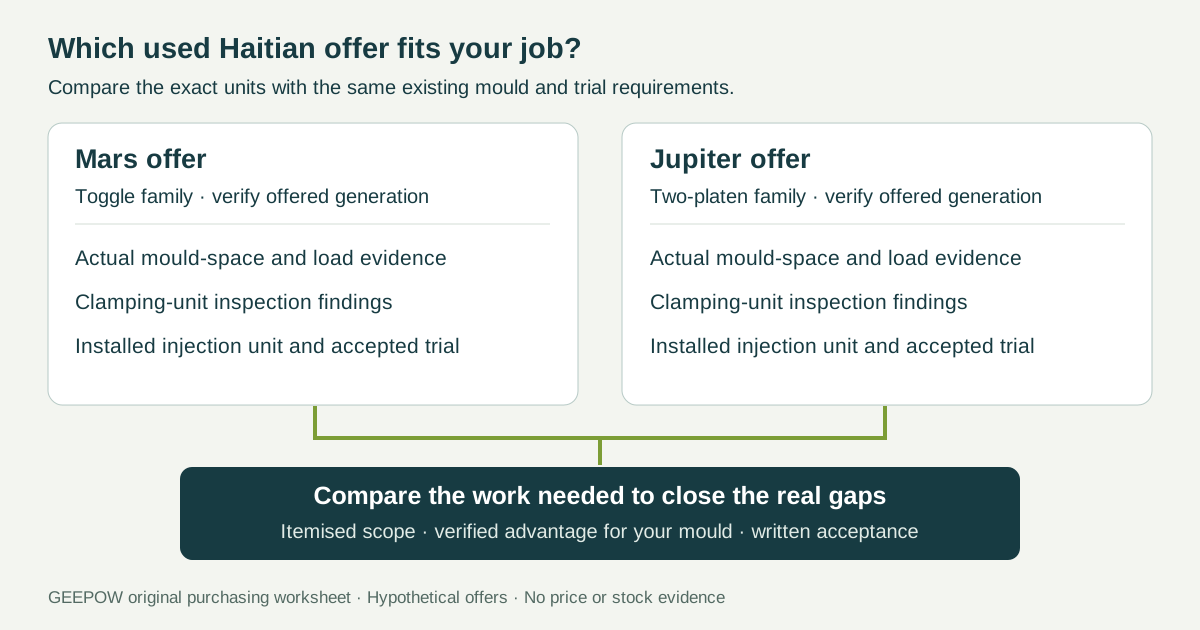
To compare the value of a used Haitian Mars and a used Haitian Jupiter, first establish which individual press can run your existing mould under an agreed trial. Then compare the documented work and equipment needed to bring each accepted offer into production. The useful choice is the offer that meets your production requirement with a defined purchase and installation scope.
Haitian identifies Mars as its servo-hydraulic toggle family and Jupiter as its servo-hydraulic two-platen family. That difference gives a buyer a reason to compare the clamping arrangement and mould-space evidence carefully. For buyers sourcing in the 500–3,300 metric-tonne clamp-force range, record each offered machine's nameplate force and unit before shortlisting. Keep the complete model, generation and injection-unit identification with the offer.
Illustration note: the comparison worksheet is an original purchasing aid. It contains no actual stock offer, machine dimensions or performance result.
Begin with the exact Mars and Jupiter being offered
The current Haitian Mars and Jupiter product pages describe generation 5 machines. Their published feature descriptions are useful for identifying the current product families. Apply an advertised feature to a used machine only when that machine's generation and installed configuration have been documented.
Ask for the nameplate photograph, full series and generation designation, clamping-unit drawing, injection-unit details, controller identification and the equipment included. If the seller refers to an older Mars or Jupiter, request the documentation for that version. Identify any replacement components or retrofits separately, including the work completed and the evidence available for checking it.
This prevents a broad family comparison from becoming an assumption about two quite different used units. A photograph, a model abbreviation and a modern brochure can each help start the enquiry. The purchase decision needs the record for the actual machine.
Compare what each clamping arrangement solves for your mould
Write down the mould dimensions, total and moving-half masses, intended opening and removal sequence, mounting arrangement and required injection process. Use the same requirements for both offers. The family architecture then becomes a set of questions to close with measurements, the applicable documentation and a trial.
| Buyer decision | Evidence to request for the Mars offer | Evidence to request for the Jupiter offer | How it affects value |
|---|---|---|---|
| Can this exact mould enter, mount and open as planned? | Applicable toggle-clamp drawing, usable mould-height range and the measured installation and removal path. | Applicable two-platen drawing, usable mould-height range, opening arrangement and measured installation and removal path. | Identify a demonstrated fit advantage and any mould, handling or layout change needed to obtain it. |
| What clamping-unit work remains before acceptance? | Inspection scope tied to the actual toggle mechanism, adjustment arrangement and lubrication requirements in its documentation. | Inspection scope tied to the actual platen-guidance, locking and clamping arrangement in its documentation. | Compare the written findings, proposed work and acceptance evidence for each individual unit. |
| Can it carry and release the intended tool? | Documented mould-load limits, support conditions and opening/ejection trial for the proposed tool. | Documented mould-load limits, support conditions and opening/ejection trial for the proposed tool. | Record the cost and responsibility for any approved support or interface change in the offer. |
| Will the installed injection unit suit the job? | Actual screw/injection-unit identification and a trial with the specified resin, mould and output criteria. | Actual screw/injection-unit identification and the same production-trial criteria. | An attractive clamping arrangement still needs an injection unit that passes the intended process. |
| What is included in getting it into production? | Itemised machine, accessories, agreed repairs, dismantling, packing and commissioning scope. | The same itemised scope, with differences and missing items identified. | Price the work needed to close the documented differences before selecting the offer. |
The table is an original procurement comparison. It provides questions for the actual machine records. Keep the detailed mould-fit checks with the two offer files so the reviewer can see how each conclusion was reached.
Pay for an advantage that the application can use
Haitian's current Jupiter page identifies its two-platen design and describes the clamping cylinders and lock-nut operation for that current series. The evidence for a used Jupiter should establish its own fitted arrangement and condition. Ask what a proposed Jupiter adds for your particular mould, such as an accepted opening arrangement or a workable installation layout, and obtain the corresponding drawing and trial evidence.
Do the same for the Mars offer. If its documented mould space, clamping condition, injection unit and acceptance trial satisfy the job, keep it in the comparison. Ask for the consequences of the remaining work in writing. This turns the family choice into an application decision that can be checked against the two offers.
Work through one two-offer example
Illustrative purchasing scenario, with no real prices or inventory. A buyer wants to transfer an existing mould and receives a Mars offer and a Jupiter offer. The seller presents the Jupiter's mould-space arrangement as an advantage. The buyer asks both sellers to demonstrate the same tool-entry, opening and removal sequence against the required part and resin.
- If both offered machines pass: compare the agreed repair findings, included accessories, site changes and acceptance terms. Retain only advantages that help the intended work or a documented future mould requirement.
- If the Mars offer needs a change: ask the responsible specialist to define that change, its acceptance evidence and who supplies it. Compare that complete offer with the verified Jupiter arrangement.
- If an advantage remains unverified: keep the relevant question open in the comparison. Request the missing drawing, inspection or trial before assigning a purchasing benefit to it.
No assumed price gap is needed to use this exercise. It gives the buyer an evidence-based list of differences to price and negotiate.
Agree the trial that closes the comparison
Keep the mould, resin, accepted part criteria and observation conditions consistent when comparing the offers. Confirm the identity and condition of each machine at the trial. Agree how any repair or replacement will be checked before final acceptance, using the used-machine acceptance-test guide to prepare the record.
The comparison supports shortlisting. Qualified personnel must assess the actual mould loads, mounting, machine condition and installation. Current family pages cannot establish the condition, remaining service life or achievable production result of an individual second-hand machine.
Questions about used Haitian value
Does a later generation automatically justify its asking price?
Compare the fitted features that serve your job, their demonstrated operation, the condition findings and the complete offer. Include a later-generation feature in the decision when its benefit for your application and its presence on that unit have been established.
Can two machines with a similar clamp-force rating be compared directly?
Use the rating as a first filter, then compare the mould-space, load, injection-unit, condition and installation evidence. Preserve the original force unit and the supporting machine documents in each offer file.
What should I send to get a useful comparison?
Send the two full machine identities, available quotations and inspection records, together with your mould drawing, mould mass, resin, part requirement and destination. Mark the requirements already verified and those that still need evidence.
Compare used Haitian offers with GEEPOW
Review the 500–3,300 tonne used injection moulding machine sourcing page, then share your Mars and Jupiter requirements or offers. Ask for the individual machine's evidence, included work and remaining questions to be set out before discussing which option offers better value for your production.