Ejector Checks for Large Used Injection Moulding Machines
Before buying a large used injection moulding machine, verify the ejector connection, usable travel, actual part release and mould ejector plate return.
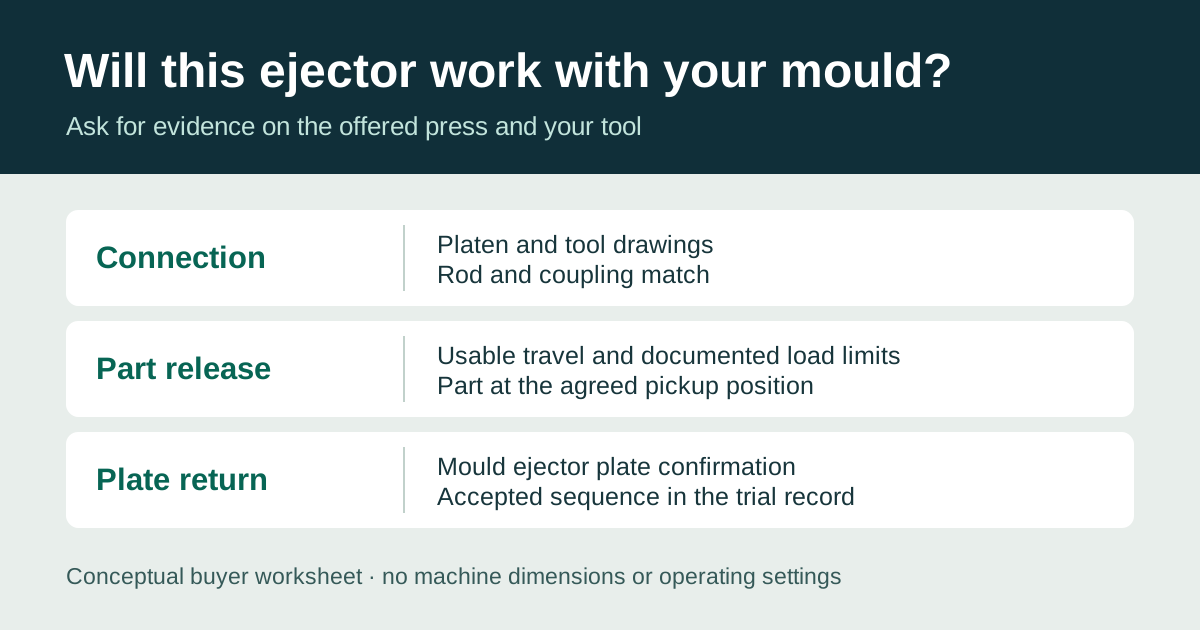
Before buying a large used injection moulding machine, verify how its ejector will connect to your tool, release the part and return the mould’s ejector plate to the required position. For a deep part, a press can have enough clamp force and opening travel yet still fail at the ejector connection, part release or hand-off to the take-out robot. Ask for a machine-specific check with the mould and removal sequence you intend to run.
Conceptual buyer worksheet. Take all travel, force and sequence limits from the exact press and mould documentation.
Read the ejector specifications separately from clamp tonnage
For buyers comparing used presses in the 500–3,300 metric-tonne clamp-force range, start with the exact model and serial. In the YIZUMI D1 technical catalogue, the UN1300D1 specifications list 274 kN ejector force and 360 mm ejector stroke, separate from clamp opening stroke and daylight. Ask for the platen drawing and the equipment actually installed. Those figures are catalogue ratings for that model. Confirm the installed hardware, working limits and condition on the quoted machine.
On a mechanically coupled tool, also ask for the rod, coupling and mould ejector plate details. DME’s FasTie catalogue shows different press-side and mould-side arrangements and gives a separate force limit for each coupler size. Use the documentation for the hardware installed on your tool. If the tool uses its own ejector actuator, have the toolmaker identify the connection and control requirements for that design.
Ask for evidence at three points in the cycle
| Buying decision | What to put side by side | When to keep it open |
|---|---|---|
| Will the press drive this tool’s ejector? | Match the tool’s required rod locations, threads or coupling, and return method to the actual press drawing and photographs. Identify the proposed hardware and who approves any adapter. | The seller supplies a hole count with no locations, or the offer says an adapter is included without an approved drawing and scope. |
| Will the part release and reach the take-out position? | Compare the toolmaker’s required travel and allowed load with the press and coupling limits. Agree the usable travel with the tool and hardware installed. For a robot hand-off, document the part position and the pickup confirmation in the intended sequence. | The quoted stroke is unloaded travel, evidence shows the mould opening only, or take-out remains unreliable after the part releases. |
| Will the mould’s ejector plate return as required? | Identify how the actual tool returns and how its position is confirmed at the relevant point in the sequence. If the tool uses a plate-position sensor, ask which controller input reflects that sensor and record the qualified technician’s check. | A screen shows that the machine actuator is back, but the seller cannot establish what confirms the tool’s own ejector plate position. |
DME’s Thinswitch is an example of a mould-mounted switch designed to confirm ejector plate return through the machine control before closure. Ask how the offered machine and your mould handle this check. The type of confirmation and when it is required depend on the tool design and manufacturer instructions.
Put part release and return into the trial terms
For a deep bin, agree with the toolmaker where the part must be presented to the gripper. A seller’s video may show the rods moving on an empty press, while the buyer needs evidence that the moulded part clears the tool, reaches the agreed pickup position and meets the agreed limits for distortion and ejector marks. Ask the technician to record the mould revision, resin, relevant settings, consecutive cycles observed, part condition and return confirmation. Distinguish displayed setpoints from measurements.
If only a substitute tool is available, state which connection or movement it demonstrates and leave production-tool acceptance open. Record who will test the intended mould, what result is required and how the parties will handle a failed check. Use the used-machine acceptance test guide to tie that evidence to payment or commissioning. Use the mould-fit dimensions guide to check mounting and the clamp opening separately. Arrange demonstrations through qualified personnel following the machine and mould instructions.
Questions buyers ask
Will a bigger ejector force rating solve sticking?
A higher rating may offer more capacity after the tool and coupling limits are checked. A sticking part can still require review of the tool and process. Ask a tooling specialist to evaluate the cause and agree the test before accepting a machine on force alone.
What can a dry-cycle video prove?
It can show visible travel or a recorded status under the demonstrated setup. If acceptance depends on releasing and handling your part, include a production-tool run with the intended removal sequence in the agreement.
See the GEEPOW used injection moulding machine sourcing page or share your ejector and take-out requirements. Include the target clamp force, mould drawing, ejector connection, required movement and planned robot or other part-removal method.