
Used YIZUMI With a Blender: What Does the Recipe Percentage Mean?
Buying a used YIZUMI with a blender? Check whether recipe percentages refer to the full batch or natural resin, then reconcile the ingredient mass records.
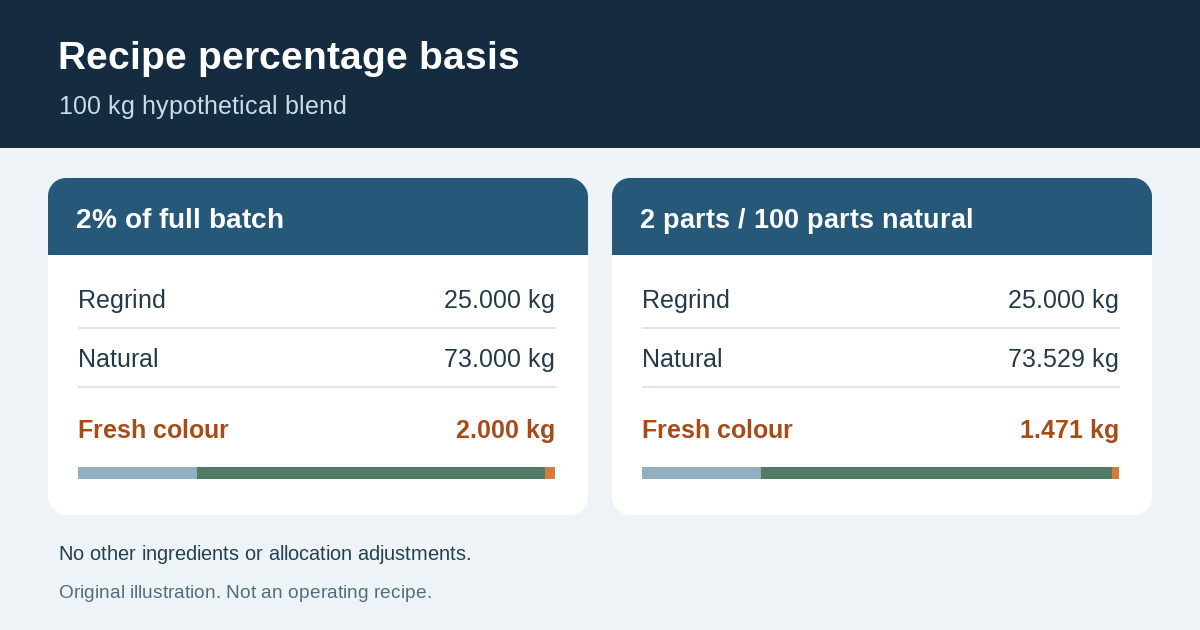
Before buying a used YIZUMI with a gravimetric blender, confirm what each recipe percentage is a percentage of. The same displayed additive number can describe a share of the whole batch or a dose relative to natural resin. Identify the actual blender controller, its active recipe and ingredient assignments, then reconcile the intended ingredient masses with the recorded dispensing results.
This is an accessory purchase question for buyers searching GEEPOW’s 500–3,300 metric-tonne used-machine procurement range. Verify the individual press’s nameplate rating and original unit separately. Neither that range nor a YIZUMI badge proves a blender is included, correctly configured or suitable for the intended blend.
The original illustration compares two hypothetical mass balances. It is a purchasing explanation, not a photograph, an operating recipe or evidence of any offered equipment.
Identify the blender independently of the press
Request the blender manufacturer, model, serial number, controller identity and software version. Photograph the ingredient-bin labels and obtain the applicable manual. Match this equipment list to the written offer, including any separate control or reporting equipment needed for the agreed demonstration.
YIZUMI’s current D1 page describes its press controller and process-data facilities. It does not identify an accessory blender supplied with a used machine. The blender’s recipe interpretation must be established from its own documented controller and configuration; press settings alone leave that question unanswered.
Write the denominator beside every ingredient
Maguire’s 4088 touchscreen manual (revision 24 September 2020) distinguishes Percent of Natural mode—batch-based regrind, additive relative to combined naturals, naturals as ratios—from Percent of Total Batch mode, where each component is a share of the whole. These definitions belong to that controller.
Conair’s SB-3 Quick Card, QCB011-0716, distinguishes additive-natural from additive-batch calculations. Confirm those definitions on the actual blender.
A hypothetical 100 kg comparison
Assume 100 kg total: 25 kg regrind, one natural and one fresh colour component; no other ingredients or special allocation features. These are hypothetical arithmetic cases, not formulations.
| Meaning of the colour requirement | Regrind | Natural | Fresh colour added | Total |
|---|---|---|---|---|
| 2% of the complete batch mass | 25.000 kg | 73.000 kg | 2.000 kg | 100.000 kg |
| 2 parts colour per 100 parts natural mass | 25.000 kg | 73.529 kg | 1.471 kg | 100.000 kg |
Case two leaves 75 kg for natural plus colour: natural = 75 ÷ 1.02; colour = natural × 0.02. Figures are rounded; these are not controller entries.
Compare these expected masses with the agreed production specification before evaluating the demonstration. The table concerns newly dispensed ingredients. It does not establish the finished blend’s pigment or additive content, which also depends on the composition of the supplied materials.
Check whether regrind changes the interpretation
The same manual documents features that alter additive allocation or regrind use. Ask the supplier to identify active features and explain their effect. The simple mass balance excludes them; it provides no settings or controller-modification instructions.
Ask the material owner what the regrind actually contains and whether it needs further colour or additives. Record the lot and approved formulation rather than assuming that all regrind is already coloured, uncoloured or compositionally identical. For the separate question of feedstock preparation and process architecture, read the recycled-material route guide.
Separate intended masses from recorded dispensing
Conair’s TB900 SB-5 datasheet, TPBX071-0624, describes diagnostics showing target and actual percentages and start/finish weights per material per batch. It also describes totals by bin and batch counts. Those are specific documented facilities, not evidence that an unidentified used blender supplies them or that a reported weight has been independently verified.
Use this original evidence brief when agreeing a demonstration with the responsible blender supplier:
- Recipe meaning: retain the active recipe identifier, ingredient-bin assignments, percentage basis and any special allocation features.
- Material identity: record each ingredient’s grade, lot and expected mass under the approved formulation.
- Actual results: retain identified batch records, component weights, alarms and deviations, plus the agreed method for checking the reported masses.
- Acceptance boundary: agree the observed run, criteria, measurement responsibilities and treatment of incomplete or interrupted batches before judging the outcome.
A target screen records an intention. A short sequence of recorded batches provides evidence for those batches under the stated conditions. Have the relevant specialist decide what additional observation or verification the purchase requires; do not convert a brief demonstration into an assumed long-term accuracy guarantee. Put the agreement into the machine-specific acceptance record.
Compare value using a defined recipe result
An included blender has purchasing value when its identity, calculation basis and demonstrated results address the intended production requirement. A lower-priced package with unexplained ingredient assignments leaves a different scope from an offer with interpretable records. Obtain actual quotations for any needed review, equipment work, trial and handover; this guide establishes no cost saving or conversion entitlement.
Buyer questions
Must every displayed recipe add up to 100%?
Interpret it using the actual controller’s mode and ingredient definitions. Ratios between naturals and additive percentages relative to natural mass are different from listing every ingredient as a percentage of the full batch.
Does a good-looking moulding prove the recipe was correct?
It documents the sample shown. Confirm ingredient identity, calculation basis, dispensing records and the product checks required by the buyer. Appearance alone does not establish those records.
Does this guide establish a YIZUMI blender option?
No. It addresses an accessory advertised with a used press. Inclusion, configuration, condition, suitability and availability all require evidence for the particular offer.
Review the 500–3,300 metric-tonne sourcing range, then send the YIZUMI and blender identities with your formulation questions. Include the intended mould, material records and destination so the accessory review can accompany the press enquiry.
Sources
- Maguire — Weigh Scale Blender 4088 Touch Screen Controller manual (revision 24 September 2020), material types and blending modes
- Conair — Working with recipes, TrueBlend SB-3 Control Quick Card QCB011-0716
- Conair — TrueBlend TB900-4 and TB900-6 SB-5 datasheet TPBX071-0624
- YIZUMI — D1 Series Two-platen Injection Molding Machine, controller section (undated current page)