Used YIZUMI D1: Check Controller Backups Before Handover
Buying a used YIZUMI D1? Separate recipe files, machine settings and application packages, then match each handover item to its controller and version.
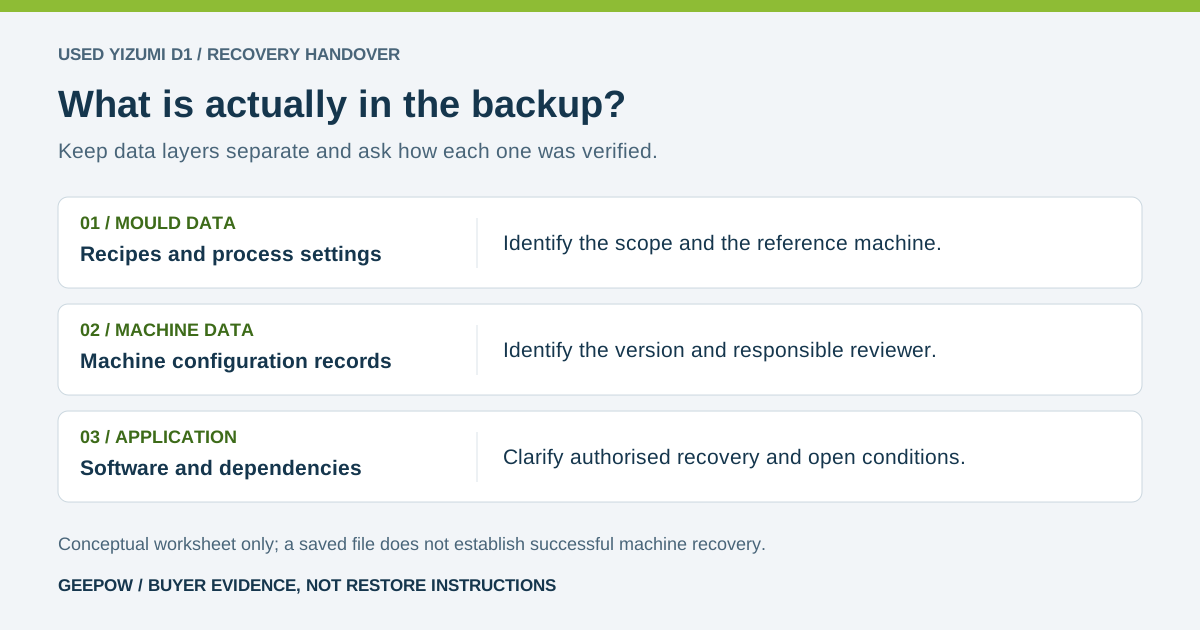
Before buying a used YIZUMI D1, request a controller handover inventory that separates mould/process records, machine configuration and application software. Match every supplied item to the offered machine and its installed versions, then record what recovery evidence exists for each layer. A USB stick labelled ‘backup’ leaves the purchase decision open until its contents and limits are identified.
This review suits buyers sourcing used or refurbished presses within GEEPOW’s main 500–3,300 metric-tonne clamp-force range. Confirm the offered press’s rating and original unit separately. The original illustration is a concept worksheet, with no actual machine, files or recovery result shown.
Start with the installed controller and its history
YIZUMI’s D1 brochure designed March 2024 describes a KEBA control system and functions including process-data storage, alarm memory and parameter-change records. That edition provides a useful starting point for questions. It does not identify the controller hardware or software now fitted to a particular second-hand press.
Request the machine serial number, controller and panel identification, displayed application/software versions, matching manuals and records of control replacements or modifications. Ask the technical reviewer to reconcile these identities before accepting files. Keep the capture date: a backup made before a retrofit needs review against the changed configuration.
Separate three layers before evaluating the backup
KEBA’s KePlast.HMI.KVB V3.05 manual, copyrighted 2016 and available through LOG IMM, distinguishes mould-specific process records in §4.54 from machine-specific settings in §§4.92–4.93. Section 4.94 separately describes machine-data backup and restoration; its illustrated screen warns about data that does not match the machine.
This is a controller-maker example, not evidence that the manual’s version or screens apply to an offered D1. Its distinctions explain why a saved mould recipe cannot establish a complete recovery package. Application software needs its own declared scope and compatibility review.
Attach a layer-by-layer evidence table to the offer
Use this original purchasing worksheet. Have the responsible service team define applicable deliverables rather than assuming every controller provides the same files.
| Layer or record | Inventory and provenance to request | Acceptance question |
|---|---|---|
| Mould/process records | Named recipes, intended mould, creation/export date and source machine | Which setups are supplied, and what remains to be qualified for your mould and resin? |
| Machine configuration | Identified settings package, capture date, controller versions and changes since capture | Has a qualified reviewer matched it to the installed machine configuration? |
| Application/software package | Exact supplied package and version; whether executable files, editable project or neither are included | Which recovery needs does the supplied material cover, and which require further supplier involvement? |
| File manifest and custody | File names, sizes, checksums where practical, source, recipient and retained copy location | Can both parties identify the same delivered files? Integrity checks do not prove usability. |
| Recovery evidence and exceptions | Review or validation report, exact versions assessed, untested items and named responsibility | What has actually been demonstrated, and which unresolved items remain before acceptance? |
Give each layer an honest evidence status
Distinguish files received, applicability reviewed and recovery validated within a stated scope. A readable copy supports the first status. A documented comparison with the actual controller supports the second. The third needs a record of the relevant validation, its environment, versions, result and limitations.
Have authorised, qualified personnel choose any validation method using the applicable machine and controller instructions. Do not request an improvised restore on production equipment to demonstrate confidence. Where suitable validation is unavailable, preserve that exception explicitly; a successful normal cycle does not close it.
KEBA’s manual also describes exports of status reports, screenshots, process logs and mould data in §4.55. Ask which of these the seller is providing. A collection of screen images should be labelled as inspection records, with the recovery capability assessed separately.
Make unresolved recovery work visible in the price
Consider two illustrative offers. One supplies recipes only. The other identifies separate configuration and application deliverables, pairs them with the installed versions and states which recovery checks remain open. Compare the cost of reaching the same agreed handover condition before judging the headline prices.
Put missing items, responsible party, quoted work and acceptance consequence into an exception list. Keep the separate D1 injection-unit and options review alongside it. Any agreed machine checks also belong in the machine-specific acceptance plan.
Buyer questions
Does a ‘full backup’ label establish recoverability?
Ask for the manifest, covered layers, exact version pairing and validation record. Accept the documented scope; leave unsupported recovery claims unresolved.
Can files from another D1 fill a missing handover item?
Do not treat a shared series name as compatibility evidence. Require machine-specific assessment by the responsible technical supplier before accepting a proposed substitute.
Does a reviewed backup prove the press is production-ready?
It addresses the stated data scope. Mechanical condition, safety functions and production performance require their own appropriate inspections and acceptance evidence.
Prepare a used YIZUMI sourcing enquiry
Review the 500–3,300 tonne used injection moulding machine sourcing page, then send the D1 identification, controller versions and open handover items. Include your mould, resin and destination so the requested offer can define the relevant inspection and documentation scope. Configuration, availability and included work require confirmation for the individual machine.