Used YIZUMI D1: Compare Injection Units Before the Price
Compare used YIZUMI D1 offers by the installed injection unit, screw and barrel package, condition and verified options before judging value.
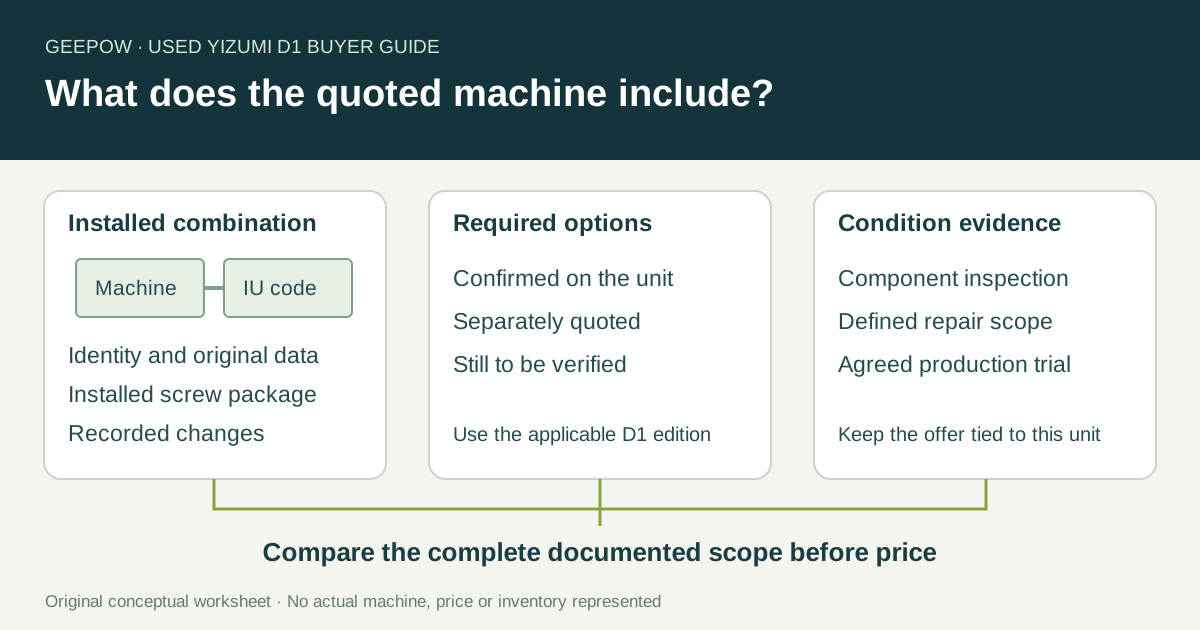
A used YIZUMI D1 offers good value when its installed injection unit and required options suit your production job, its condition is documented, and the quotation defines what it takes to reach the agreed trial. Record that combination before comparing prices. A lower machine price needs further assessment if the screw, injection configuration or necessary equipment remains unidentified.
For buyers considering used YIZUMI presses within a 500–3,300 metric-tonne clamp-force procurement range, start with the exact nameplate rating and its original unit. Then identify the injection unit separately. The D1 model, year, installed configuration, condition and availability all need evidence for the individual machine being offered.
The accompanying original diagram is a comparison worksheet. It represents the evidence to collect, with no actual machine, inventory or quotation shown.
Find the injection-unit identity behind the D1 offer
YIZUMI’s February 2023 D1 brochure provides a useful documentary example. Its UN1100D1 specification and dimension pages show combinations labelled IU4800, IU6800, IU9000 and IU10900. The associated tables distinguish injection and power data. This demonstrates why the full documented combination belongs on a comparison sheet. These are catalogue references for that edition, not a statement about the configuration of a used machine or the ability to interchange its equipment.
Ask the seller for the complete identification, the applicable original specification and evidence of the installed injection equipment. If a barrel, screw, motor or control component has been replaced, request the part identification and relevant service record. Have the responsible technical reviewer reconcile those changes with the original configuration and your intended material.
Use the shot-size and resin matching guide for the application calculations. Here, the procurement task is to establish which configuration and options you are actually buying.
Read the optional-equipment list as a question sheet
The same D1 brochure’s standard and optional equipment chart lists a mixing screw, bi-metallic screw barrel, special screw components and increased injection stroke among its optional injection features. It also lists hydraulic options such as a larger plasticizing motor and plasticizing during mould opening. Those distinctions give a buyer concrete items to identify when an offer advertises a material package or a production feature.
Mark every feature your process requires as confirmed on the offered machine, separately quoted, or still unverified. Ask for its identity, condition and appropriate demonstration. Keep the brochure edition with the review. A feature shown in literature for D1-N, D1S, DP-N or SKIII requires its own series and configuration check before it can inform an offer for a D1.
Build one value comparison record for each offered machine
This original table turns the D1 configuration questions into a usable purchasing record. Attach the answers to the quotation so the lower headline price can be assessed against a defined scope.
| Offer item | Evidence to retain | How it affects the value decision |
|---|---|---|
| Exact D1 and installed injection combination | Machine identity, applicable edition of the original data, injection-unit identification and any replacement records. | Establishes whether the compared offers describe the equipment you need. |
| Required screw and barrel package | Actual component identity and material specification where claimed, inspection findings, repair or replacement scope. | Reveals whether the quoted price includes a verified material package or leaves expenditure unresolved. |
| Required injection or plasticizing options | Itemised installed options, technical confirmation for the intended process and an agreed test of the required function. | Shows which offers already include the required equipment and which need a separately approved scope. |
| Condition of the identified equipment | Inspection tied to the offered unit, service findings and written responsibility for work before the trial. | Provides a basis for evaluating the repair allowance and outstanding technical questions. |
| Trial and acceptance boundary | Which mould, resin, auxiliaries and installed options will be used, with agreed records and criteria. | Makes a demonstration relevant to the configuration being purchased. |
| Complete included scope | Machine, identified options, agreed work, inspection, packing and delivery responsibilities, with exclusions. | Allows comparison of documented expenditure for a defined starting condition. |
Ask for records that belong to the offered controller
YIZUMI’s D1 product page describes alarm and process-parameter-change memory in its controller section. Use that as a prompt to ask what records can actually be retrieved from the offered machine. Confirm the installed controller, available access and any control-system changes before relying on a demonstration of that capability.
Keep the retrieved record with the machine identity, trial date and configuration used. It can support review of that run. A controller screen or historic programme also needs interpretation against the machine’s actual hardware and the production job.
Compare the complete decision, including unresolved items
Consider an illustrative pair of offers. One identifies its injection unit, required screw package and included work, with inspection findings ready for review. The other has a lower quoted price but leaves the barrel identity and an essential plasticizing function unresolved. The second offer needs those answers and any necessary work priced before the buyer can judge its value.
Ask your technical reviewer to confirm whether proposed changes are feasible and appropriate. Include the approved scope and its quotation in the comparison. If a required conversion has no agreed technical basis, keep that question open in the purchasing decision and evaluate other available configurations.
For the witnessed production run, agree a machine-specific acceptance test. Record the equipment and options used, the observed outcome and any remaining work. The purpose is a traceable buying decision for the particular second-hand machine.
Buyer questions
Does the D1 name establish the injection unit and options?
Request the complete machine and injection identification. Compare it with the relevant original documents, the installed equipment and any service changes. Put the final combination into the offer.
Should I pay more for a larger injection unit?
Have the proposed configuration assessed for your mould, resin and production requirements. Then compare the quoted complete scope for the suitable offers. Size alone leaves both application fit and condition unresolved.
Can a seller’s brochure prove a bi-metallic barrel is fitted?
The 2023 D1 chart identifies that barrel package as an option. Ask for the offered component’s identity and supporting documentation, together with its condition findings. A catalogue option establishes a question to verify on the individual machine.
Discuss a used YIZUMI D1 offer with GEEPOW
Review the 500–3,300 tonne used injection moulding machine sourcing page, then send your YIZUMI D1 identification, injection-unit details and required options. Include the mould, resin, destination and the questions left open in the quotation so the sourcing and inspection scope can address them.