
Used YIZUMI for Thick-Wall PMMA Lenses: Trace Each Pass
When buying a used YIZUMI for a thick-wall PMMA lens, link first-pass cavity, index history and finished samples before accepting the trial.
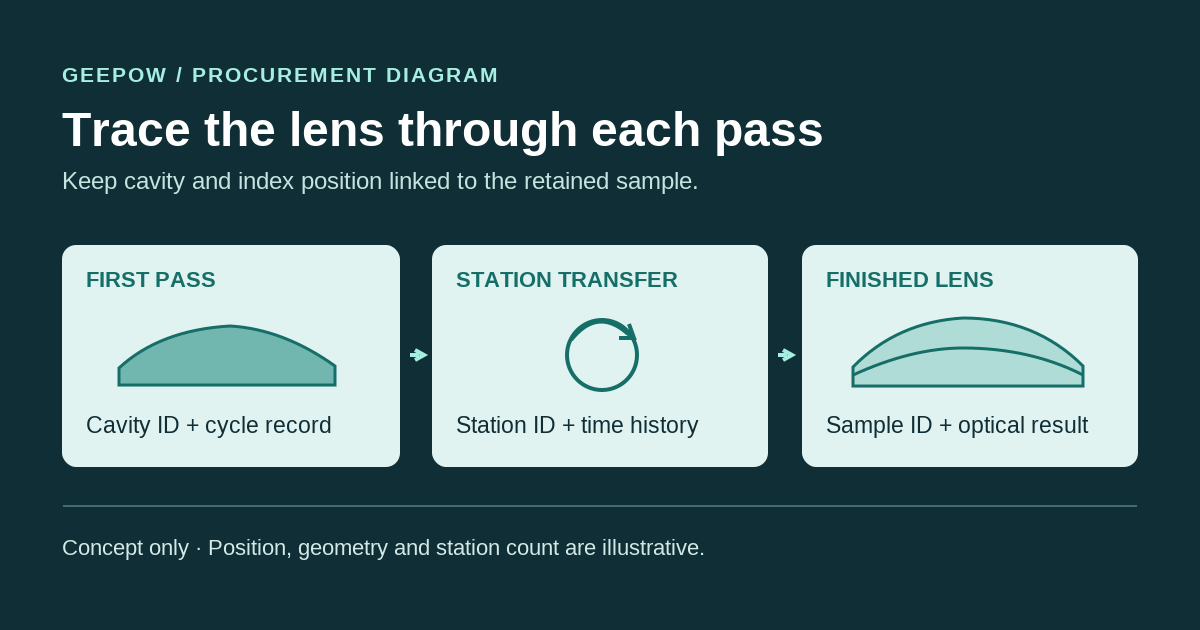
For a multi-pass PMMA lens, ask the seller to prove that the trial can link a finished sample to its mould cavity, index positions and time between passes. Use that record to decide whether a defect pattern is traceable and which check must be repeated before shipment. A basket of unlabelled clear parts cannot support that decision.
The purchasing diagram shows an illustrative evidence chain for a multi-pass lens. The geometry, position and station count are conceptual.
Two YIZUMI demonstrations show why the route matters
On its thick-wall lens equipment page, YIZUMI describes a UN700D1M demonstration with two injection units, six stations and a PMMA lens. The reported route adds robot removal and laser sprue trimming after moulding. Its data are from factory testing and are marked as reference figures.
YIZUMI separately documents a two-layer PMMA-on-PMMA lens demonstration using a UN400C3-BTP and a different rotary arrangement. The two records illustrate why the written trial plan should name the actual control, tool and index sequence. The 500–3,300 metric-tonne GEEPOW sourcing range is a search filter. Confirm the offered machine’s nameplate clamp rating in its original units and confirm its installed configuration from machine-specific documents.
Ask for a run record that survives the index cycle
Ask the seller and toolmaker to map a part through the cavity at the first pass, the positions it visits and the cavity identifiers at later passes. A cavity identifier can follow a mould insert, while a station identifies where that insert sits in a particular step. Record both if they differ. Note the time from the first recorded pass to the next, the mould-temperature readings available at agreed points and any stoppage or restart that changes the sequence.
Keep the material grade and lot attached to each injection unit in the same record, along with resin-preparation data the technician can verify. Export what the installed control can reliably show. If it cannot supply timestamped records, agree a witnessed event log and mark missing measurements as open.
| Proposed evidence | What to record | Purchase decision it supports |
|---|---|---|
| First-pass baseline | Tool revision, initial cavity ID, resin lot and time. Record first-pass observations or samples only where the agreed safe trial permits them. | Shows whether an observation was already visible early in the route. Mark hidden layers that could not be observed. |
| Index and dwell history | Station sequence, index position and timestamps, mould-temperature readings available under the trial method, and reason for any interruption. | Lets the buyer compare normal runs and restarted runs without pooling the two conditions. |
| Finished sample trace | Run and sample ID, sequence of cavity and station IDs, inspection location, and whether the part was inspected before or after trimming. | Keeps specimen history and the first observed defect location available for a repeat trial. |
| Unresolved groups | Counts and observations by cavity, position and run condition, with excluded, missing and rejected samples visible. | Lets the buyer set the smallest useful repeat check and name the party responsible for closing it. |
Use the sample pattern to decide what to repeat
If a mark repeats in a particular cavity under different index positions, ask the tool team to examine that cavity and its part history. If the same effect appears after pauses across several cavities, ask for a repeat with the interruption and timing recorded. These patterns narrow the next check. Have the technical team confirm the cause before agreeing to machine repairs or a tooling change.
BYK-Gardner distinguishes total transmission from scattering and notes that scattering can arise inside a transparent part or at its surface. Have the customer’s optical specialist specify which characteristic matters, the test location and the method’s suitability for the actual lens geometry. Keep the method and result with the sample ID. A preparation plaque can document the agreed material comparison, while the finished lens still needs its own agreed evidence.
Put open items in the purchase scope
Define which mould, resin and station sequence the offer includes, which measurements and samples must remain traceable, and who can release the machine. For each unresolved group, name the evidence to obtain, who pays for the repeat trial or repair, and the point at which the buyer may accept the remaining limitation. Record these items with the used-machine inspection protocol and the machine acceptance trial.
Buyer questions
Can a first-pass sample be collected from every tool?
Only if the qualified site team can collect one through an agreed safe procedure. If a pass is inaccessible, rely on the accessible records and record the missing observation in the acceptance file.
What if the controller records cycle numbers but omits cavity identity?
Ask the tool team for a witnessed cavity-to-position map and align that map with the cycle log and labelled samples. If the map cannot be confirmed, retain that limitation in the purchase decision.
Should the brochure cycle time go into the written acceptance criteria?
Set the target for your tool, resin and full process route, including the agreed sampling and inspection steps. Use the supplier demonstration to identify questions for the actual machine.
See GEEPOW’s 500–3,300 metric-tonne used-machine sourcing range. Then send the lens drawing, proposed pass sequence and trial brief to discuss the scope for a specific used unit.