
Why a crates injection machine deserves a closer look
A crates injection machine is not just another piece of plastic-processing equipment. For breweries, beverage distributors, logistics suppliers, and anyone running reusable transport packaging, it sits at the center of a very practical business question: how do you make rigid, stackable crates that survive hard handling without tying up too much capital or floor space?
That question matters because crate production is a different game from commodity packaging. Beer crates and other beverage carriers need thick walls, reinforced corners, stable stacking, and enough dimensional accuracy to move cleanly through filling lines and warehouse racks. A machine built for this job has to deliver strong clamping, stable injection, and repeatable molding on large parts. If it does not, defects show up quickly: warped frames, inconsistent handholds, weak ribs, and crates that do not stack the way operators expect.
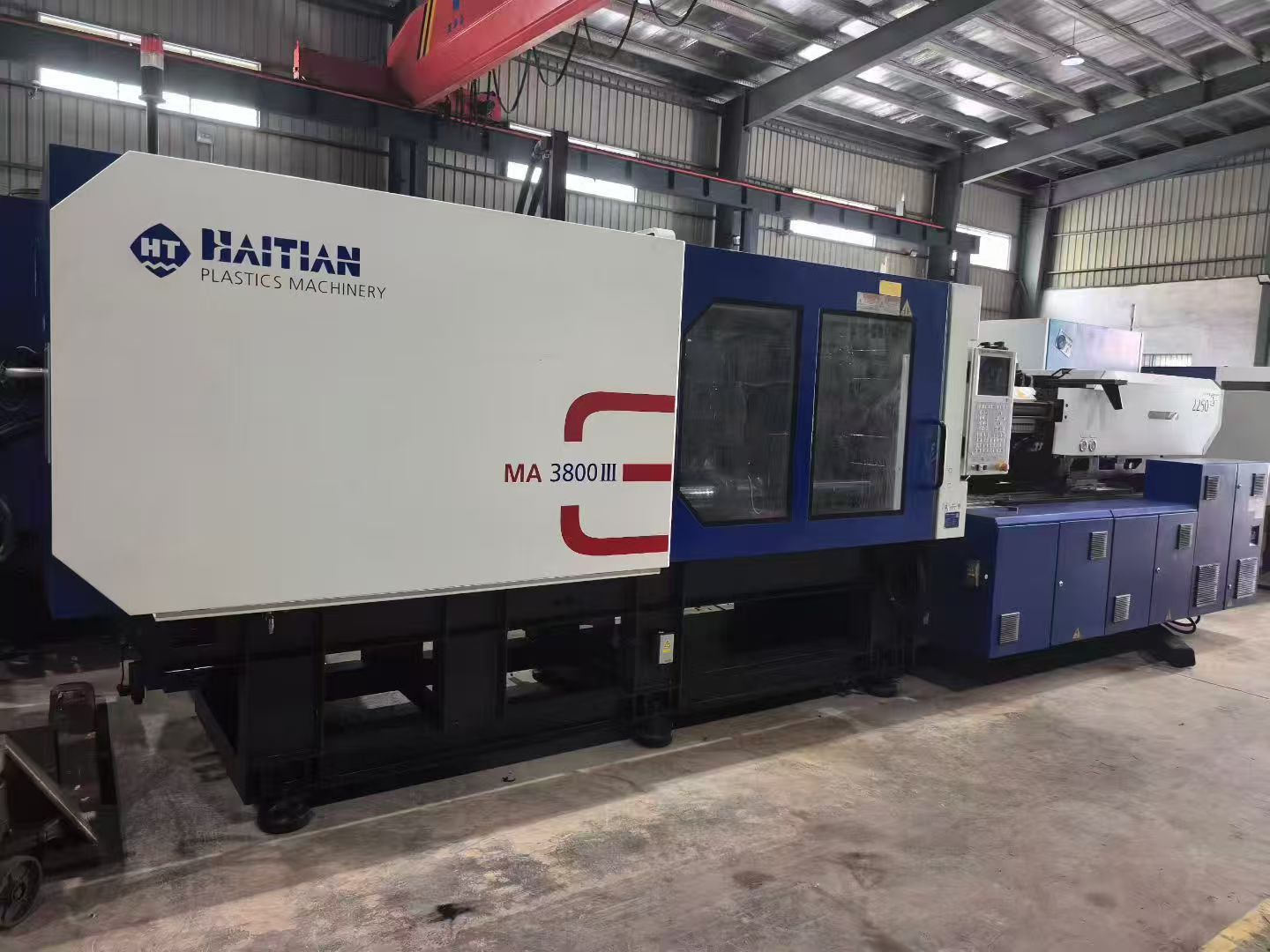
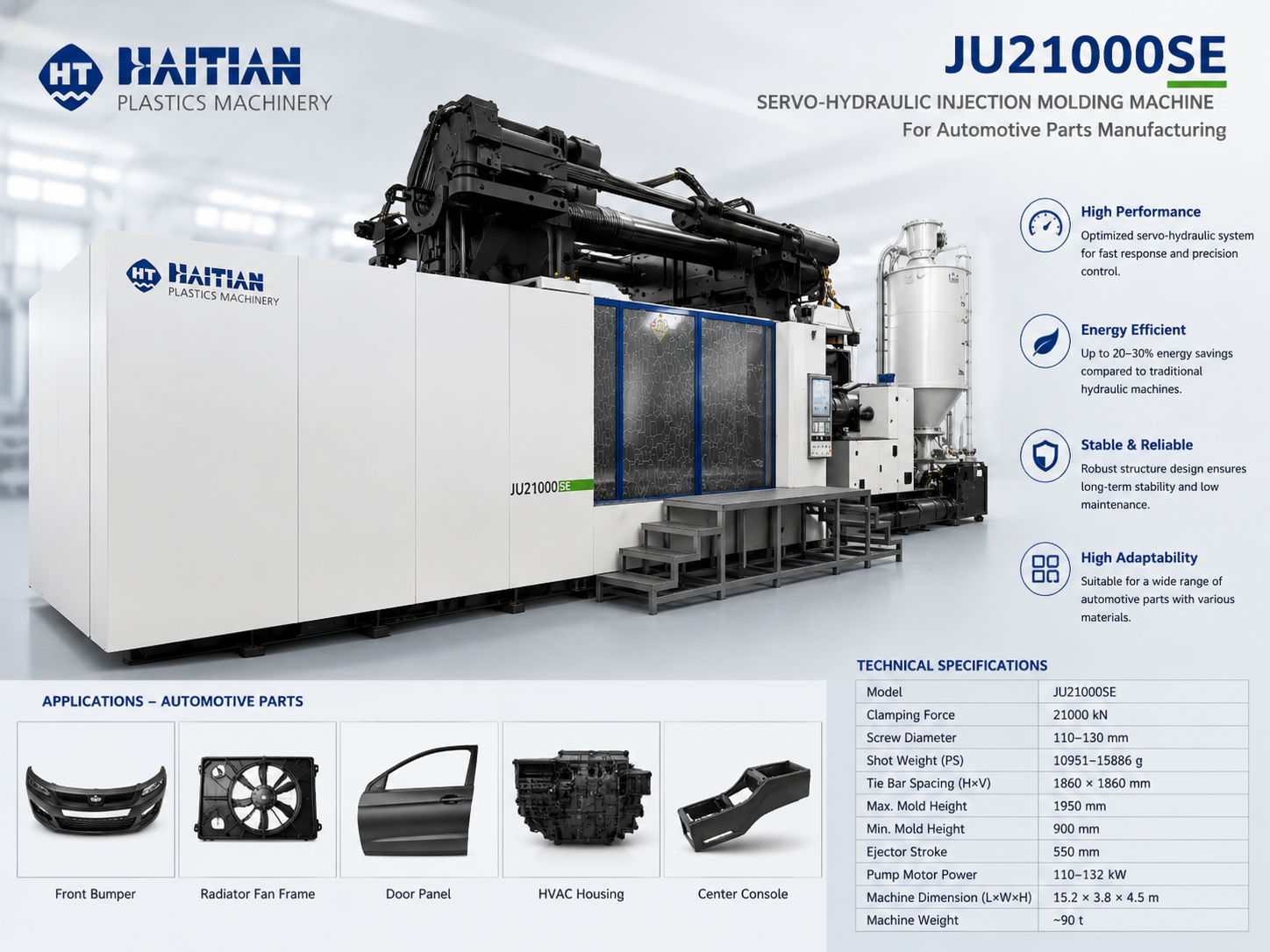
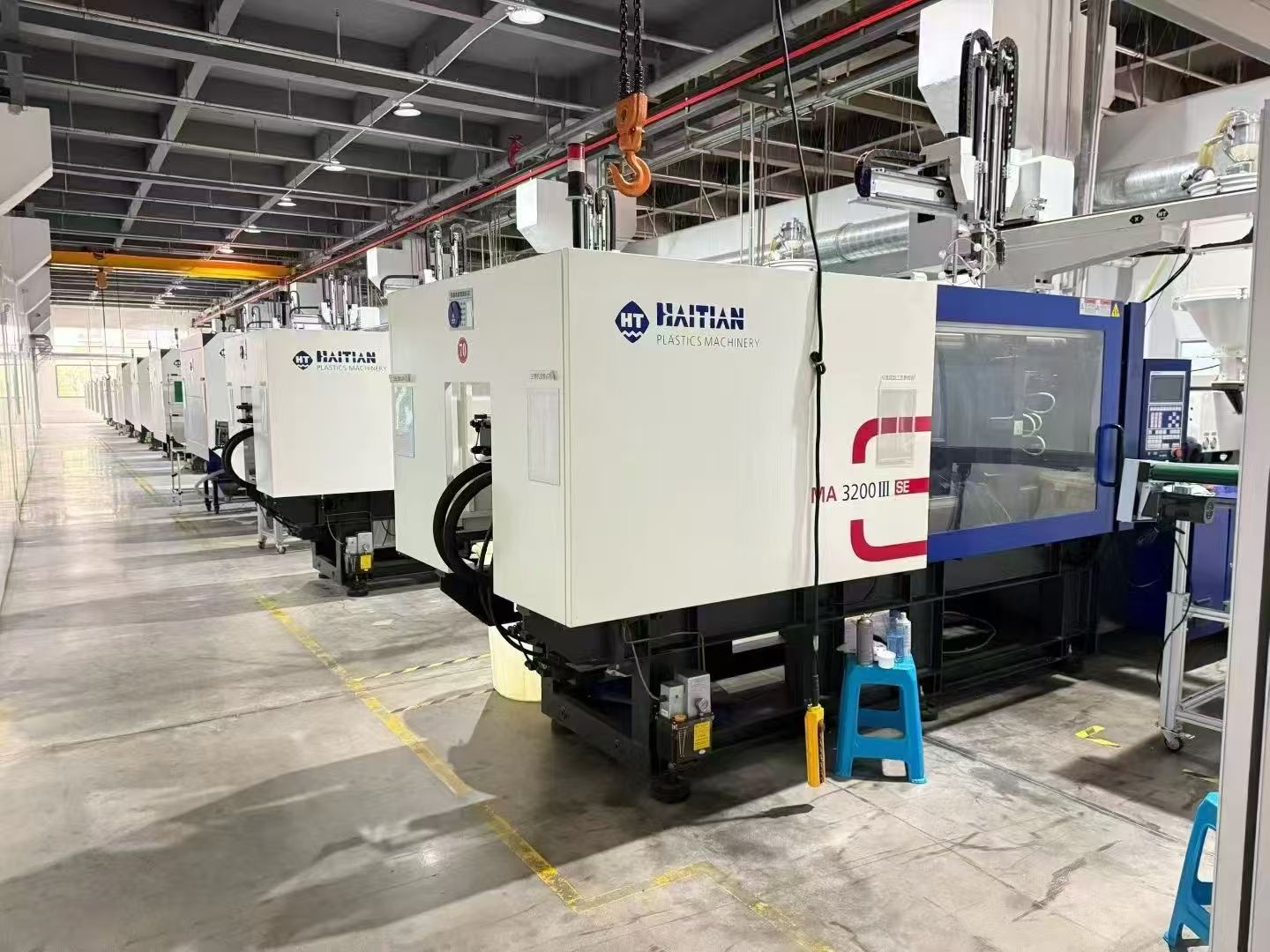
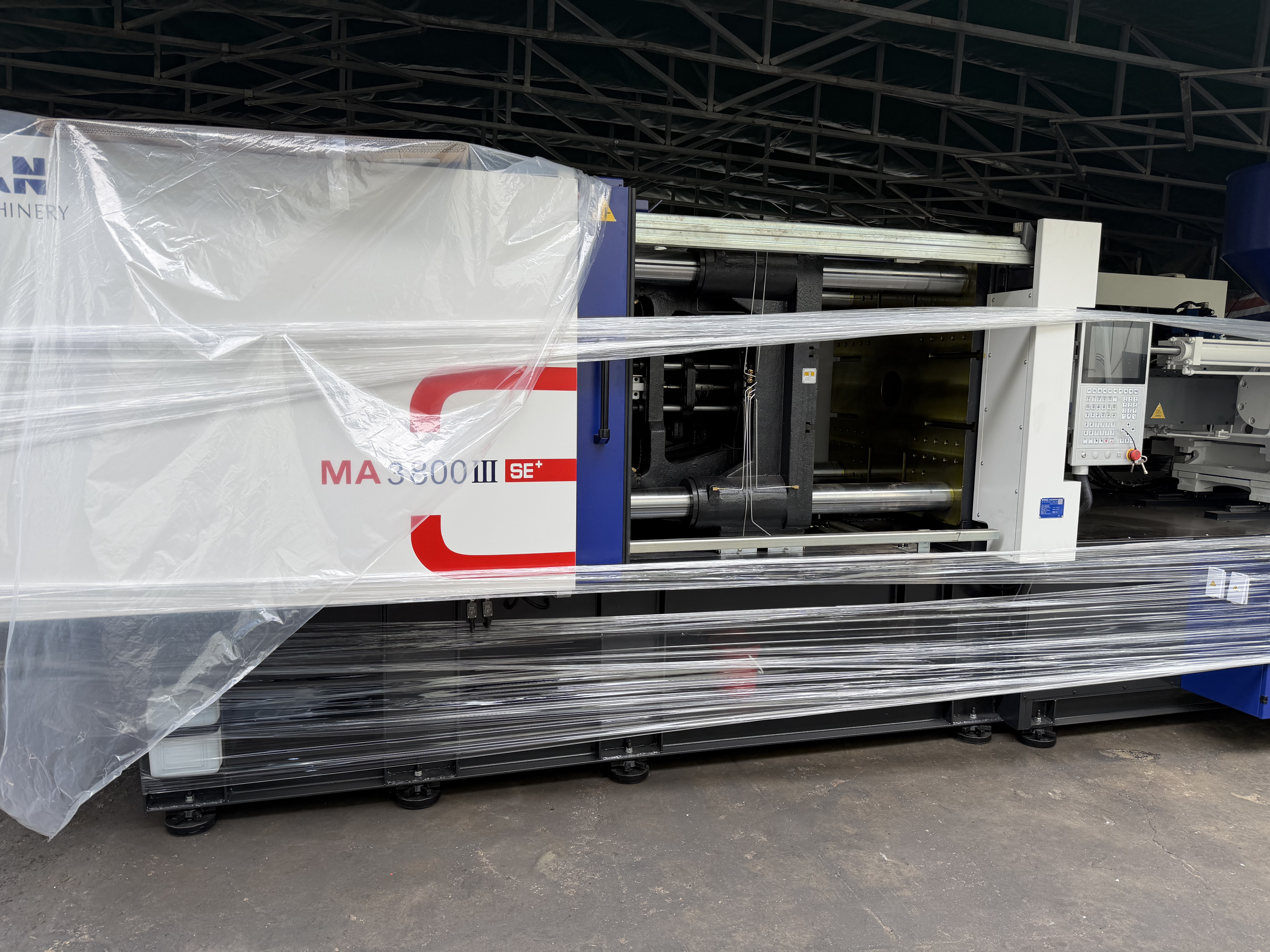
This article looks at the topic through a buyer’s lens, using the MA10000III large injection molding machine shown in the supplied material as a reference point. It is a useful case because it sits right where crate manufacturing decisions are made: between output volume, part quality, and the realities of industrial equipment budgeting.
What the machine is designed to do
The basic process is straightforward. Molten plastic is injected into a mold that forms the crate body, including lattice sidewalls, internal ribbing, reinforced corners, and handhold openings. Once cooled, the part is ejected and the cycle repeats. That sounds simple, but the mold and the machine need to work together very closely, especially on large, thick-walled products.
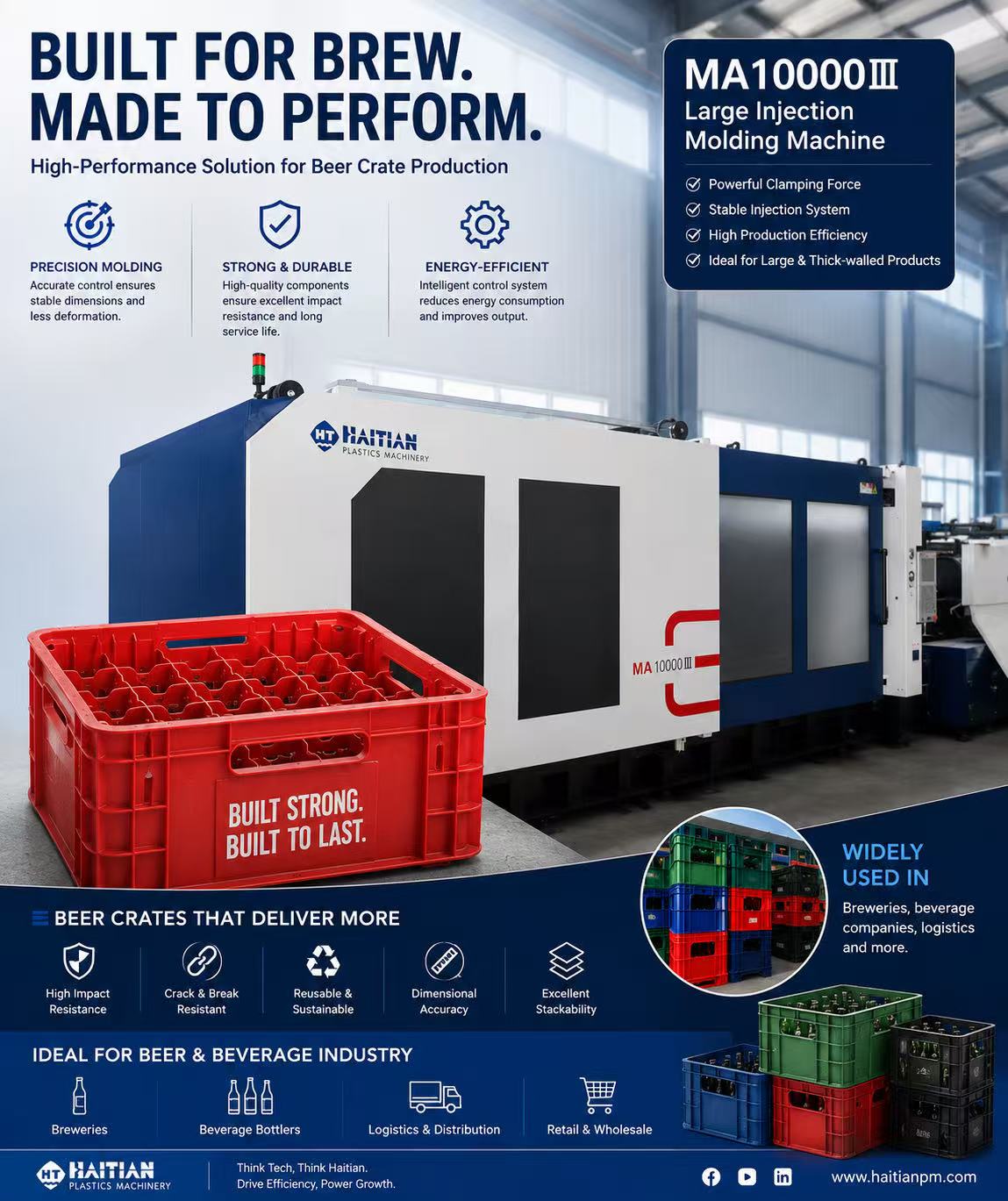
The MA10000III is presented as a large injection molding machine for plastic crate production, specifically beer crates and other beverage or transport crates. The image material highlights several practical selling points: powerful clamping force, a stable injection system, high production efficiency, and precision molding with accurate control and less deformation. It also emphasizes strong and durable construction, energy-efficient operation, and suitability for large and thick-walled products.
Those are exactly the features a buyer should care about. Crates are not decorative parts. They are load-bearing, reusable, and frequently handled in rough conditions. If the molding process is inconsistent, the cost shows up later in damaged crates, sorting problems, and more reject material than a plant manager wants to see.
A case study view: what good crate production looks like
Think about a brewery or beverage logistics operation that needs stackable plastic crates for bottle transport. The crate has to be light enough to move in volume, yet strong enough to be reused many times. It needs open lattice sides for visibility and ventilation, but not so much open area that the structure loses stiffness. The corners must hold up under stacking, while the handholds should be shaped for repeated lifting and carrying.
In that setting, a crate making machine is really a production discipline, not just equipment. The machine must fill the mold evenly so the ribs form properly. It must maintain stable pressure so the crate does not end up with thin weak spots. It must cool and eject consistently, because dimensional drift can make crates unstable when stacked on pallets or warehouse shelving. The poster’s emphasis on dimensional accuracy and excellent stackability is not marketing fluff; it speaks to the main operational risk in this category.
There is also a sustainability angle, though buyers should keep their feet on the ground. Reusable transport packaging only earns the “reusable & sustainable” label if the crates last long enough in circulation. A crate injection molding machine can support that by producing crack and break resistant parts, but the real durability depends on the mold design, resin choice, wall thickness, and handling environment. That is worth saying plainly, because too many packaging projects assume a machine alone will solve a product life problem.
Key traits to compare before buying
Clamping force and machine size
For large crates, the clamp has to hold the mold shut against injection pressure. If the force is inadequate, flash, parting-line issues, and dimensional inconsistency become more likely. The supplied information does not give an exact tonnage for the MA10000III, so it would be wrong to pretend otherwise. What matters is whether the platform is truly sized for large-part injection molding and whether the mold footprint fits the intended crate design.
Injection stability
A stable injection system helps the machine deliver consistent fill from shot to shot. That is especially important for thick-walled products where uneven flow can leave visible stress patterns or local weak points. For crate production, stability tends to matter more than flashy speed claims. A fast machine that makes inconsistent crates is not a bargain.
Precision and deformation control
Crates have to stack. That sounds obvious, but it is where many projects stumble. If the frame corners are slightly out of square or the base is not flat enough, stackability drops fast. The machine’s precision molding capability, combined with a properly engineered mold, is what keeps those parts within a usable window.
Durability and energy efficiency
Industrial buyers usually want two things at once: long service life and lower operating cost. The material provided says the machine is strong, durable, and energy-efficient, with reduced energy consumption and improved output. That is the right direction, though real savings depend on how the plant runs it, what resin is used, and how well the maintenance team keeps the system tuned.
How crate product requirements shape the equipment choice
Not every plastic crate manufacturing equipment setup is built for the same end use. Beer crates, for example, often need heavier reinforcement than simple storage totes. Beverage returnable packaging sees repeated loading and unloading. Distribution crates may face conveyor wear, corner knocks, and storage compression. A recycled-content crate, if the product specification allows it, can introduce its own processing challenges as well.
That is why a recycling crate injection machine and a fresh-resin system are not always interchangeable in practice. The machine may look similar from the outside, but the material behavior can be different. Reprocessed material can be more variable, and variability shows up in fill behavior, surface finish, and impact resistance. Buyers should be careful not to assume one setup will handle every resin blend with equal ease.
The red crate shown in the supplied image has the familiar features of a serious transport crate: open lattice sides, molded ribbing, integrated handholds, reinforced corners, and a smooth glossy surface typical of injection molding. Whether that exact crate is the final output of the pictured machine or a representative example is not clear, so it is better treated as a visual cue for the type of part the equipment is meant to produce.
Where used equipment can make sense
GEEPOW Machinery says it offers used injection molding machines from 90 to 2800 tons, with more than 300 models in stock. For buyers, that is relevant because a crate project often starts with a reality check on budget. A used industrial crate injection machine can be a practical route when the goal is to expand capacity without committing to a brand-new platform.
Used machinery, though, should be selected with discipline. Buyers need to confirm maintenance condition, control system status, screw and barrel wear, hydraulic performance, and whether the machine is genuinely suitable for the mold size and part weight. The phrase “used” should never be treated as a shortcut around process verification. It can reduce capital outlay, but it does not reduce the need for technical inspection.
Common mistakes buyers make
The first mistake is focusing only on tonnage. A crate project is not won by a big number on a spec sheet. Mold design, shot capacity, injection stability, and clamping performance all matter together.
The second mistake is ignoring stack performance until late in the project. If the crate is not dimensionally consistent, warehouse problems follow. That is not a cosmetic issue; it affects transport efficiency and product safety.
The third mistake is assuming the machine alone controls durability. The material grade, wall distribution, cooling balance, and gate position all contribute to whether the finished crate is crack and break resistant in real use.
And one practical warning: if your target is beverage logistics, check how the crate will be handled outside the molding room. A design that looks fine on paper can still be awkward for conveyors, lift points, or pallet patterns.
Questions to ask before you commit
Before buying a plastic crate molding machine, ask how the supplier approaches mold compatibility, material processing, and part consistency. If the answer is vague, keep digging. Ask whether the platform is intended for large & thick-walled products, how it supports precision molding, and what kind of production rhythm the plant has in mind.
For a crate production line, it also helps to ask about downstream handling. Will you need automated takeout, stacking, or inspection? Is the mold designed for easy maintenance? Can the machine hold repeatable process settings across shifts? These are practical questions, not paperwork exercises.
FAQ
Is a crates injection machine only for beverage crates?
No. Beverage and beer crates are a common use case, but the same general equipment category can support logistics bins, transport containers, and other large rigid plastic products, depending on mold design and machine capacity.
Does a high-output machine guarantee better crates?
Not by itself. Output matters, but crate quality depends on the full setup: machine stability, mold quality, material selection, and process control.
Can used equipment be a smart choice?
Yes, if it is inspected carefully and matched to the actual part requirements. A used injection molding machine can be a sensible option for buyers who need capacity and want to manage capital spending, but it should be evaluated like industrial equipment, not like a commodity item.
A practical next step for buyers
If your project centers on stackable plastic crates, the smartest approach is to start with the part, not the machine. Define the crate geometry, the handling environment, the material strategy, and the target production rhythm. Then compare machines against that package of requirements.
For buyers looking at used platforms, GEEPOW Machinery’s stock of injection molding machines in the 90 to 2800 ton range may be worth reviewing, especially if you are building or expanding a crate line and need a machine with the right scale rather than the newest badge on the enclosure. The best purchase is the one that fits the mold, the product, and the plant’s actual operating discipline.