Used Haitian Export Packing: Verify Moisture Protection Before Shipment
Compare used Haitian export-packing offers by protected items, enclosure, moisture assumptions, completion evidence and responsibility after opening.
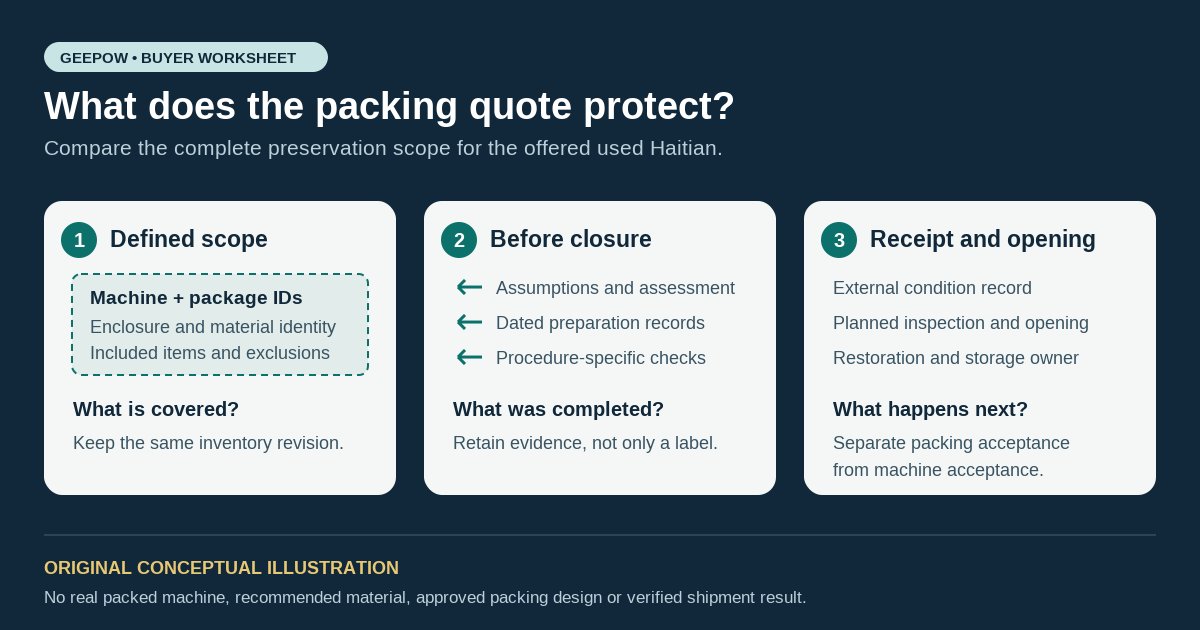
Before accepting “export packing included” on a used Haitian quotation, ask for a preservation scope tied to the offered machine, its shipping units and the expected transport and storage conditions. Compare the proposed enclosure, its technical basis, completion records and receiving responsibilities before assigning value to a moisture-protection claim.
For sourcing within the 500–3,300 metric-tonne clamp-force range, preserve the actual nameplate rating and original unit separately. Neither that procurement range nor a model number establishes inventory, configuration or packing requirements. For a refurbished press, identify which work and checks will be completed before the packing record begins.
Illustration: an original purchasing worksheet. It shows evidence to request at three stages, with no real packed machine, material recommendation or verified shipment result.
Attach the protection scope to the sale inventory
Begin with the full model, generation and serial number, then reconcile the agreed sale inventory with the proposed package IDs. Ask which parts of the main press, cabinets, detached equipment and loose accessories the preservation proposal covers. Have the responsible machine-service provider identify preparation and later removal requirements using the applicable machine and component instructions.
List exclusions explicitly. A quote may describe the main machine while leaving an auxiliary cabinet or a box of spares outside its stated protection scope. Ask the packer to connect each protected group to a package record. Use the Haitian Jupiter III shipping-unit checklist for identity, packed dimensions and mass; those records address a separate transport question.
Ask where the moisture assumptions come from
Annex 3 of the 2014 IMO/ILO/UNECE CTU Code identifies cargo, timber supports, pallets, porous packaging and packing conditions as moisture sources. It also distinguishes condensation on the container from condensation on the cargo. An externally covered press therefore still needs a defined preservation proposal. This dated technical reference informs these questions; it is not a claim of regulatory compliance.
Send the packer the destination, proposed route, expected handling stages and any storage before installation. Mark uncertain durations rather than inventing them. Ask which conditions the quoted system covers and what change would require another review, such as extended storage or an inspection that opens the enclosure.
Clariant’s DESI PAK calculator requests package dimensions, dunnage weight and moisture, film type, packing temperature and humidity, allowable internal humidity and storage duration. It requires users to assess whether its result suits the application. These are prompts for the specialist’s documented basis, not a bag-count prescription for a used Haitian.
Identify the system behind the word “wrap”
Cortec’s CorrLam LD VpCI data sheet, revised 13 July 2017, describes a specific foil laminate containing corrosion-inhibiting film and identifies heat-sealability as a feature. It places suitability assessment on the user. This shows why a named preservation material and its instructions matter; it does not approve that product for your press or prove the completed enclosure.
Ask whether the proposal uses a moisture-controlled enclosure, corrosion-inhibiting materials, another approved approach or a combination assessed by its supplier. Record the exact materials and the specialist’s reasoning. Do not specify a default combination of barrier film, inhibitor and desiccant merely because each appears in an export-packing catalogue.
If a seller submits only an outer-cover description, request the missing preservation boundary and technical assessment. If it submits a detailed enclosure design, ask how penetrations, separate packages and later access are addressed in that proposal. The purchasing objective is to compare defined work, with the responsible specialists choosing and applying the method.
Compare the two packing scopes before comparing prices
This original matrix turns the preservation proposal into five reviewable purchasing records. Complete it for each offer and keep the same inventory revision throughout the comparison.
| Compare | Evidence in each offer | Value question |
|---|---|---|
| Protected scope | Machine/package IDs, included items, exclusions. | Same equipment covered? |
| Enclosure | Material identity, boundary and closure proposal. | System defined? |
| Design basis | Conditions, duration, moisture inputs, specialist review. | Assumptions justified? |
| Completion | Dated pre-closure and closure records. | Proposed work demonstrated? |
| Later opening | Inspection, restoration and storage responsibilities. | Remaining work included? |
Illustrative comparison, with no real offers or prices: offer A says “film wrap and dry packs included”, but gives no protected-item list or storage assumption. Offer B names its enclosure system, identifies covered equipment and excludes prolonged storage after opening. The useful next step is to price the work needed to close A’s missing scope and B’s stated exclusion.
Neither description alone establishes adequate protection. Ask the technical reviewer whether each complete proposal is suitable, then compare the accepted scopes. A lower headline packing charge is difficult to assess while essential work remains undefined; a longer description earns value only when it specifies relevant, included deliverables.
Retain evidence before the enclosure closes
Agree the packer’s handover record in the purchase documents. Request dated photographs linked to the machine and package IDs, the preparation record, material identities, relevant assessment revision, closure checks required by the chosen procedure, exclusions and the person responsible for completion. Record unresolved findings before dispatch.
Where indicators or monitoring devices are included, ask the provider to identify their type, location and agreed interpretation. Keep their records with the packing file. Define who reviews damage, an opened enclosure or a missing record, and who authorises further work. Retain sensitive machine documents through the agreed project channel.
Define what happens when protection is opened
The 2014 CTU Code also explains that cold cargo exposed to warm, humid air during unpacking can develop cargo sweat; its discussion specifically includes machinery. Have the receiving specialist define the transition from protected storage to opening for the actual conditions. This guide supplies no universal waiting period or humidity target.
Agree who receives the packages, documents their external condition, arranges required inspection and records the condition found after opening. If customs or another authorised inspection opens a package earlier, identify who assesses and restores the preservation arrangement before further transport or storage. Put the scope and any quoted responsibility into the offer.
Moisture-protection acceptance and machine acceptance remain separate. An intact enclosure or an indicator reading is not a complete inspection of the press. Use the used-machine quotation scope checklist to assign packing, inspection and later restart responsibilities to named providers.
Buyer questions
Should I ask for more desiccant packets?
No universal packet count follows from the machine’s clamp rating. Request the enclosure-specific assumptions, product selection and sizing assessment.
Does a packing-material data sheet prove protection was completed?
No. A material description supports product identification. Keep the packer’s completion evidence and the receiving inspection separate from the supplier’s published material properties.
Can I reuse the packing specification from another Haitian?
Use it as a reference for discussion. Have the responsible providers assess the actual equipment, shipping units, route, storage and receiving plan before including a preservation scope in this purchase.
Send a defined packing enquiry
Review the 500–3,300 tonne used injection moulding machine sourcing page, then share your used Haitian export-packing brief. Include the machine identity, sale inventory, destination, proposed shipment and storage, existing packing quotation and its exclusions. Request an itemised preservation scope and evidence package for that individual machine.