Used YIZUMI for Laundry Baskets: One Press for Body and Lid?
Select a used YIZUMI for laundry baskets by checking body and lid jobs separately, then compare shared-press changeovers with parallel good-part production.
One used YIZUMI can be shortlisted for both a laundry-basket body and its lid only after each mould and process has been assessed separately, followed by a production plan that accounts for the two jobs sharing one press. Buying a machine that suits the larger body leaves the lid’s injection requirement, mould installation and available production time unresolved.
This guide addresses buyers searching within GEEPOW’s 500–3,300 metric-tonne used-machine procurement range. Confirm the offered press’s exact nameplate clamp rating, original unit, installed injection equipment and condition. A model number or workshop photograph is a starting point for identification.
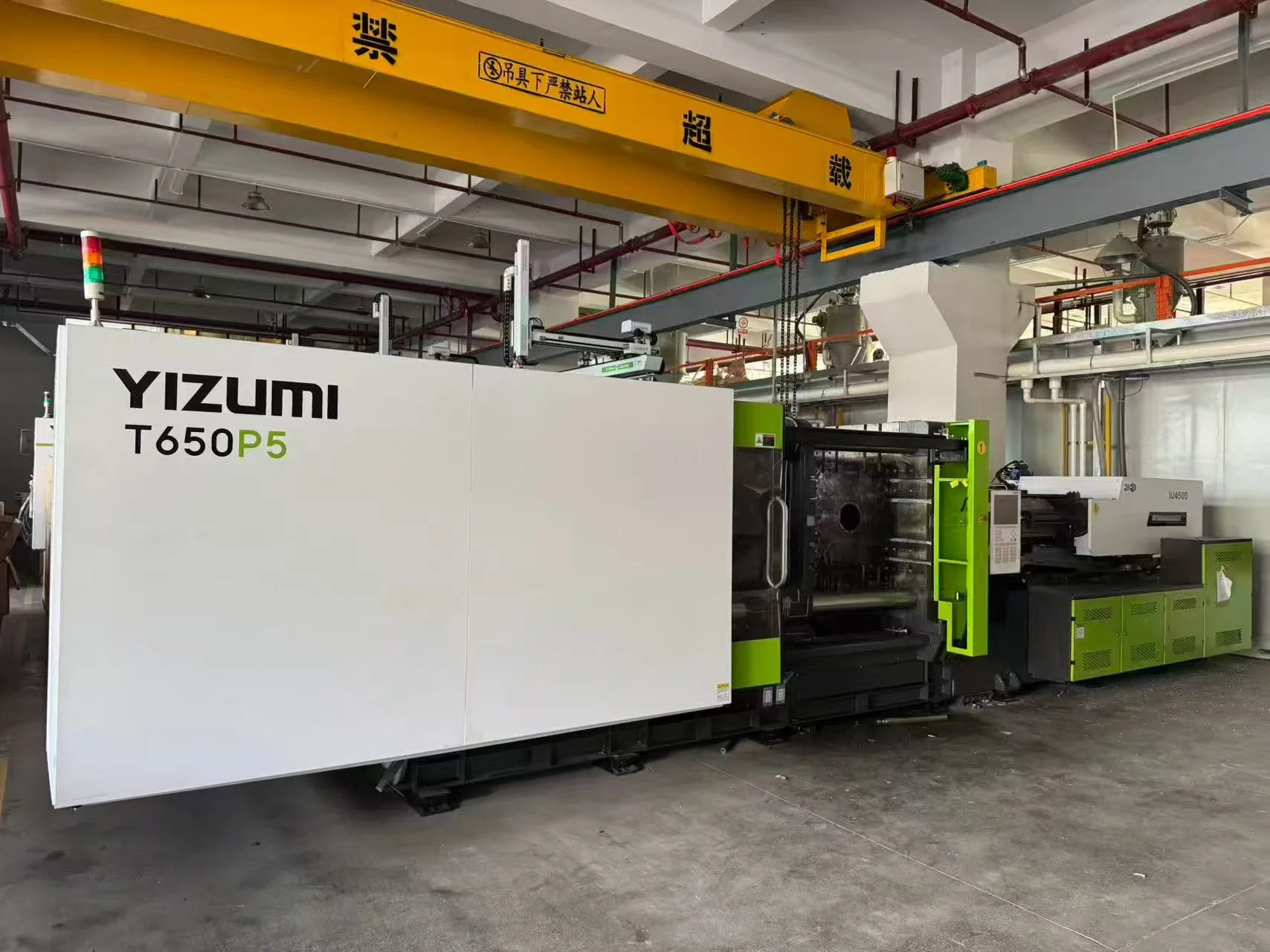
Photo note: this genuine, previously authorised archive photograph shows T650P5 and IU4500 markings. It is a different machine-family reference from the UN650A5 exhibition example below. It does not show the reported basket demonstration, establish that the photographed machine made baskets, identify its present configuration or condition, or prove current availability. Surrounding equipment is not an inclusion list.
A documented application, with two distinct jobs
YIZUMI’s report dated 8 November 2023 describes PLASTIMAGEN demonstrations using UN650A5 for a PP laundry basket and FF300 for a PP laundry-basket lid. Its listed examples are one-cavity products: a 510 g basket measuring 45 × 35 × 55 cm, and a 120 g lid with a stated diameter of 45 cm. The report says its displayed data came from factory testing and are reference-only.
These are separate manufacturer examples. The report does not establish that the displayed body and lid form a matching set. They illustrate why a basket project can contain two different moulding jobs; they do not select a used machine for your drawings.
Read the photographed candidate against the right document
YIZUMI’s TP5 catalogue, designed in March 2026, lists T650P5/4500 with a clamping force of 6,500 kN. The same column gives 930 × 930 mm tie-bar spacing, 900 mm opening stroke and a 350–900 mm mould-thickness range. Those are reference values for that catalogue configuration, not verified measurements of the photographed unit. TP5 documentation does not substitute for UN650A5 documentation or establish an upgrade relationship for an individual machine.
Match the actual machine and installed unit to the applicable records before checking either tool. The catalogue’s shot-weight column is labelled PS, with a GPPS calculation note. Keep the intended PP full shot separate from that reference-material figure. Use the mould-fit guide for the dimensional review.
Make a two-job suitability sheet
ARBURG’s September 2022 Plasticising guide separately considers dosage volume, melting capacity, injection flow and recovery during cooling, and discusses excessive dwell at low utilisation. Use this context to request each job’s usable window; its numerical guidance is not a universal YIZUMI limit.
This original worksheet keeps the two applications separate during the technical review.
| Evidence | Basket-body job | Lid job |
|---|---|---|
| Tool identity and release | Body drawing, mould envelope, opening, ejection and extraction. | Own drawing, mounting, height and release requirements. |
| Actual injection requirement | PP grade, full shot including runners, filling and recovery. | Own full shot, usable metering and thermal window. |
| Accepted output | Samples and repeated run records against body requirements. | Lid records and buyer-defined product pairing checks. |
| Job transition | End-of-run and removal scope. | Installation, material/colour transition and restart acceptance. |
Request the shot-size and resin assessment for both tools. Have the technical reviewer establish each job’s usable window and acceptance requirements; a body trial leaves the lid question open.
Compare completed sets, not the faster job
For your own matched product, define how many bodies and lids constitute one saleable set. Agree its fit and function checks separately. Then use qualified good-part rates, rather than brochure dry-cycle figures or the number of attractive samples shown.
Hypothetical planning example: suppose the requirement is 600 sets, each needing one accepted body and one accepted lid, with no beginning inventory. Assume trials have established 100 good bodies/hour and 150 good lids/hour. These invented rates are unrelated to the exhibition examples and are not machine-performance claims.
| Production route | Illustrative time balance | What remains to establish |
|---|---|---|
| One qualified press, jobs run consecutively | 600 ÷ 100 + 600 ÷ 150 = 10 running hours. Adding an assumed 2 hours for the complete changeover/restart gives 12 elapsed hours. | Both moulds and processes must qualify on that same press; verify the actual transition allowance. |
| Two qualified presses, ready to start together | Body job: 6 hours. Lid job: 4 hours. Parallel completion takes 6 elapsed hours under these assumptions. | Both cells need the required resources; include actual setup and other delays when planning. |
The example excludes additional delays and assumes the stated good-part rates already include rejects in their measurement. Parallel production changes elapsed time, not the ten total running hours calculated here. Record any excess unpaired parts, inventory constraints and competing jobs. Neither route has an established cost advantage without actual quotations and operating evidence.
Use the result to choose the purchasing scope
A shared-press proposal is ready for commercial comparison when both tools have an accepted technical basis and their combined jobs fit the required production window. If only the body is demonstrated, keep lid capability and scheduling conditional. Compare a separate-machine route when the shared arrangement leaves an unresolved process or capacity constraint.
Ask the offer to identify the press, installed injection unit, included equipment, required work, both trial scopes and handover records. Confirm responsibilities and destination commissioning separately. This guide does not establish stock, price, refurbishment completion, achievable output, energy saving, warranty or delivery timing.
Buyer questions
Does a body-capable press automatically suit a lighter lid?
No. Assess its installed injection configuration and usable process window for the lid, alongside that mould’s installation and release requirements.
Can I compare an A5 offer with the T650P5 photograph?
Use the photograph only as its labelled archive reference. Obtain the A5 machine’s own identification and applicable documents; the TP5 catalogue is not its build record.
Can the exhibition figures become my output commitment?
No. Retain their stated reference-only factory-test boundary. Establish the intended tools’ good-part rates, product acceptance and production plan for the individual used machine.
Review the 500–3,300 metric-tonne sourcing range, then send both mould requirements, required sets and available production window. Include the machine identity, resin grades and destination so the enquiry addresses the complete basket project.
Sources
- YIZUMI — PLASTIMAGEN MEXICO 2023 (8 November 2023), separate basket and lid examples and factory-test limitation
- YIZUMI — TP5 Series Precision Energy-Saving Injection Molding Machine (designed March 2026), T650P5/4500 reference specification
- ARBURG — Plasticising, document 526421_EN_GB_092022, design basis on page 19